

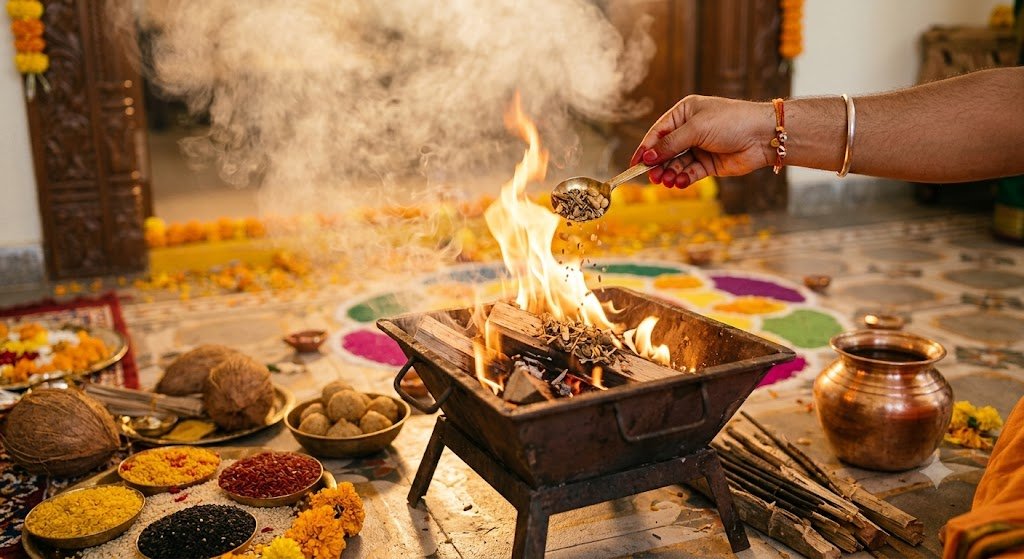
Griha Pravesh Rituals: Complete Griha Pravesh Puja Vidhi, Muhurat, Samagri & Checklist
Griha Pravesh rituals mark the traditional entry of a family into a new home. In Hindu households, moving into a new house is often treated as an important life milestone, and a Griha Pravesh Puja is performed to begin this new chapter with prayers, blessings, and auspicious customs.
From selecting the right Griha Pravesh Muhurat and preparing the entrance to performing Ganesh Puja, Vastu Shanti Puja, Kalash Sthapana, Navagraha Shanti Puja, and Griha Pravesh Havan, the ceremony can involve several interconnected rituals.
However, Griha Pravesh traditions are not identical across India. The exact Griha Pravesh Vidhi, mantras, sequence, offerings, and customs may vary according to regional traditions, family practices, sampradaya, and the priest conducting the ceremony.
This complete guide explains the meaning of Griha Pravesh, different types of house entry, auspicious date and time for Griha Pravesh, essential Griha Pravesh Puja Samagri, entrance rituals, Havan, first kitchen traditions, Tulsi planting, practical do’s and don’ts, and a complete reader-ready checklist.
Key Takeaways
- Griha Pravesh is a traditional Hindu house-entry ceremony performed when entering a new or suitably prepared home.
- Griha Pravesh Muhurat refers to the auspicious date and time selected for the ceremony according to the family’s tradition and Panchang.
- Common rituals include Ganesh Puja, Kalash Puja, Kalash Sthapana, Vastu Shanti Puja, Navagraha Shanti, Havan, Aarti, and Prasad.
- The Griha Pravesh Puja Samagri should be prepared in advance and confirmed with the priest.
- The entrance ritual may involve a Kalash, coconut, and mango leaves, although practices vary across regions.
- A First Kitchen Fire Ritual may be performed after entering the home.
- Tulsi Planting After Griha Pravesh is another customary practice followed by many Hindu families.
- A detailed Griha Pravesh Items Checklist can help organize Puja Samagri, decorations, kitchen essentials, and guest arrangements.
- Griha Pravesh traditions differ by region, family, sampradaya, and priest, so there is no single ritual sequence that applies to everyone.
- Apartments and modern homes can also accommodate Griha Pravesh rituals with appropriate space and fire-safety arrangements.
What Is Griha Pravesh?
Griha Pravesh literally refers to entering a home. In traditional Hindu practice, it is a ceremony associated with entering a newly constructed, newly purchased, renovated, or otherwise prepared residence.
The ceremony provides a formal occasion for the family to pray for:
- Peace and harmony in the household
- Prosperity and abundance
- Health and well-being
- Protection and auspiciousness
- Success in the family’s new beginning
- Positive spiritual environment
For many families, the ceremony is also deeply emotional. A house may have taken years of planning, saving, construction, or financial preparation. Griha Pravesh transforms that physical property into a place associated with family life and memories.
Griha Pravesh vs Housewarming Ceremony
The terms Griha Pravesh and housewarming ceremony are often used interchangeably, but they can carry slightly different meanings.
A housewarming ceremony is a broad term for celebrating entry into a new home. Griha Pravesh specifically refers to the Hindu religious and traditional ceremony associated with entering a dwelling.
A modern housewarming may simply involve family, food, and celebration, while a traditional Griha Pravesh may include:
- Muhurat selection
- Sankalp
- Ganesh Puja
- Kalash Puja
- Vastu Shanti
- Navagraha prayers
- Havan
- Aarti
- Prasad
- First cooking ritual
Families can adapt the ceremony according to their own traditions and circumstances.
1. Types of Griha Pravesh and When They Are Performed
Traditional Hindu practices describe different circumstances under which Griha Pravesh may be performed. Among the terms encountered in traditional discussions are Apoorva, Sapoorva & Dwandwah Griha Pravesh.
The precise interpretation can differ between textual traditions and regional practices, so the family’s priest should be consulted when determining which category applies.
Apoorva Griha Pravesh
Apoorva Griha Pravesh generally refers to entering a newly constructed house for the first time.
Sapoorva Griha Pravesh
Sapoorva Griha Pravesh is traditionally associated with returning to or re-entering a residence after a period of absence or under particular circumstances described by traditional practice.
Dwandwah Griha Pravesh
Dwandwah Griha Pravesh is another traditional category associated with entering an existing residence following particular circumstances, such as renovation or rebuilding.
Because terminology and ritual interpretation vary, it is better to follow the guidance of a knowledgeable priest rather than applying a generic online definition to every situation.
2. Griha Pravesh Muhurat: How the Auspicious Time Is Selected
One of the most searched aspects of Griha Pravesh is the Griha Pravesh Muhurat.
In Hindu tradition, a Muhurat is an auspicious period selected for beginning an important activity. For a house entry, families traditionally consult a Panchang to identify a suitable date and time.
The Auspicious Date and Time for Griha Pravesh can depend on several factors, including:
- Tithi
- Nakshatra
- Vara or weekday
- Lagna
- Planetary considerations
- Sunrise and sunset
- Location of the property
- Family circumstances
- Traditional astrological considerations
This means a Griha Pravesh date suitable for one city or family may not necessarily be the same for another.
Why Location Matters
Muhurat calculations can involve local astronomical timings. Therefore, the date and exact time should ideally be determined for the location where the house is situated.
How Far in Advance Should You Select the Muhurat?
Ideally, start planning several weeks before the intended ceremony.
This gives you enough time to:
- Consult the priest.
- Identify suitable dates.
- Confirm the ceremony duration.
- Arrange the required Samagri.
- Complete cleaning and repairs.
- Coordinate family members.
- Arrange food and Prasad.
- Prepare the home.
3. Complete Griha Pravesh Vidhi: Step-by-Step Rituals
There is no single universal sequence followed by every Hindu family. However, a traditional Griha Pravesh Vidhi may contain several of the following stages.
Step 1: Clean and Prepare the House
The house should be cleaned before the ceremony.
Pay particular attention to:
- Main entrance
- Living room
- Puja area
- Kitchen
- Floors
- Bathrooms
- Windows
- Balconies
Any major construction, painting, plumbing, or electrical work should preferably be completed before the ceremony.
Step 2: Decorate the Main Entrance
Families may decorate the entrance with:
- Rangoli
- Flowers
- Mango-leaf toran
- Diyas
- Swastik or Om symbols
- Kumkum
- Haldi
- Rice
- Floral garlands
Step 3: Griha Pravesh Entrance Ritual
The Griha Pravesh Entrance Ritual is the formal entry into the home.
Depending on regional tradition, the householder or couple may enter at the selected Muhurat while carrying or accompanying a decorated Kalash.
Step 4: Kalash Puja / Kalash Sthapana
Kalash Puja / Kalash Sthapana is commonly associated with Hindu worship and is frequently included in Griha Pravesh ceremonies.
A traditional Coconut and Mango Leaves Kalash may contain clean water and be decorated with mango leaves and a coconut.
Step 5: Ganesh Puja
Ganesh Puja is commonly performed during important beginnings.
Lord Ganesha is traditionally worshipped before undertaking significant activities, and families seek blessings for an auspicious beginning.
Step 6: Vastu Shanti Puja
Vastu Shanti Puja is one of the important rituals associated with an elaborate Griha Pravesh ceremony.
Vastu traditions concern the relationship between a dwelling, its spatial arrangement, directions, and occupants.
Vastu Shanti vs Vastu Dosha Shanti
Vastu Shanti Puja is generally performed as part of seeking auspiciousness and harmony for the dwelling.
Vastu Dosha Shanti may be performed when a family believes particular Vastu-related concerns exist in the property.
A religious ritual should not be considered a substitute for correcting actual structural, electrical, plumbing, fire-safety, or building-code problems.
Step 7: Navagraha Shanti Puja
The Navagraha Shanti Puja may be included in a more elaborate Griha Pravesh ceremony.
Whether Navagraha Puja is included depends on the family’s tradition and the priest’s guidance.
Step 8: Griha Pravesh Havan
The Griha Pravesh Havan is a sacred fire ritual performed as part of many traditional housewarming ceremonies.
Because Havan involves fire and smoke, practical safety is important.
Before beginning:
- Keep the Havan Kund on a stable heat-resistant surface.
- Keep curtains and combustible materials away.
- Ensure adequate ventilation.
- Keep children supervised.
- Keep loose clothing away from the flame.
- Follow apartment or building fire-safety rules.
- Ensure the fire is completely extinguished afterward.
4. Griha Pravesh Puja Samagri: Complete Shopping List
Preparing the Griha Pravesh Puja Samagri is one of the easiest ways to avoid last-minute stress.
However, there is no single shopping list that applies to every ceremony. The priest should provide the final list based on the exact rituals being performed.
Basic Puja Samagri
- Kalash
- Clean water
- Coconut
- Fresh mango leaves
- Akshat/rice
- Kumkum
- Roli
- Haldi
- Sandalwood
- Flowers
- Garlands
- Fruits
- Sweets
- Betel leaves
- Betel nuts
- Sacred thread
- Panchamrit ingredients
- Incense sticks
- Camphor
- Cotton wicks
- Ghee
- Diyas
- Puja cloth
- Aasan
- Bell
- Aarti plate
Havan Samagri
- Havan Kund
- Havan Samagri
- Suitable wood pieces
- Ghee
- Camphor
- Grains
- Dried herbs or prescribed offerings
- Coconut
- Fire-safe base
5. Complete Griha Pravesh Items Checklist
Ritual Items
- Kalash
- Coconut
- Mango leaves
- Clean water
- Kumkum
- Haldi
- Roli
- Rice/Akshat
- Sandalwood
- Flowers
- Garlands
- Fruits
- Sweets
- Betel leaves
- Betel nuts
- Panchamrit ingredients
- Sacred thread
- Puja cloth
- Aasan
- Incense
- Camphor
- Ghee
- Cotton wicks
- Diyas
- Aarti plate
- Bell
Decoration
- Rangoli
- Mango-leaf toran
- Flowers
- Flower garlands
- Diyas
- Entrance decorations
- Puja backdrop, if desired
Kitchen
- Cooking vessel
- Milk
- Rice
- Sugar
- Ingredients for chosen sweet dish
- Serving bowls
- Spoons
- Drinking water
Tulsi
- Tulsi plant
- Pot or planting area
- Suitable soil
- Water
- Appropriate location
6. First Kitchen Fire Ritual
The First Kitchen Fire Ritual is a meaningful housewarming custom associated with beginning food preparation in the new home.
Some families prepare kheer, while others prepare another traditional sweet dish.
A simple approach is:
- Clean the kitchen.
- Prepare the cooking area.
- Keep ingredients ready.
- Begin cooking according to family tradition.
- Complete any associated prayer or offering.
- Offer the food as Prasad where appropriate.
- Share it with family members.
7. Tulsi Planting After Griha Pravesh
Tulsi Planting After Griha Pravesh is followed by many Hindu families.
Tulsi has a significant place in Hindu household traditions and is commonly associated with devotion and auspiciousness.
If your family follows this custom:
- Select a healthy Tulsi plant.
- Prepare a clean pot or suitable planting space.
- Use appropriate soil.
- Place it where it receives suitable sunlight.
- Water it according to its needs.
- Follow any family-specific prayer or ritual.
8. Griha Pravesh Do’s and Don’ts
Griha Pravesh Do’s
- Confirm the Muhurat early.
- Ask the priest for a customized Samagri list.
- Complete major construction and repairs.
- Prepare the entrance.
- Keep the Havan area safe.
- Prepare the kitchen.
- Keep elderly family members comfortable.
Griha Pravesh Don’ts
- Don’t assume every ritual is compulsory.
- Don’t copy a random online Samagri list.
- Don’t ignore fire safety.
- Don’t leave everything for the ceremony morning.
- Don’t treat Vastu remedies as a replacement for building safety.
- Don’t make the ceremony unnecessarily stressful.
9. Complete Griha Pravesh Day Checklist
Before Leaving for the Ceremony
- Muhurat confirmed
- Priest contacted
- Family members ready
- Puja Samagri packed
- Flowers purchased
- Fruits purchased
- Prasad ready
- Kalash prepared
- Coconut available
- Mango leaves available
- Havan materials packed
- Kitchen ingredients ready
Before the Puja Starts
- House cleaned
- Entrance decorated
- Rangoli completed
- Toran installed
- Puja area arranged
- Priest’s seating arranged
- Family seating arranged
- Havan area prepared
- Ventilation checked
- Drinking water available
- Bathrooms ready
- Electrical and gas systems checked
During the Ceremony
- Griha Pravesh entrance completed
- Kalash Puja performed
- Ganesh Puja performed
- Vastu Shanti performed, if included
- Vastu Dosha Shanti performed, if included
- Navagraha Shanti performed, if included
- Griha Pravesh Havan performed, if included
- Aarti completed
- Prasad offered
After the Ceremony
- First Kitchen Fire Ritual completed, if applicable
- Tulsi planted/placed, if applicable
- Prasad distributed
- Havan completely extinguished
- Puja materials stored
- Ceremony area cleaned
- Kitchen cleaned
- Essential household items arranged
FAQ: Griha Pravesh
1. What is Griha Pravesh Puja?
Griha Pravesh Puja is a traditional Hindu house-entry ceremony performed when entering a new or newly prepared home. It may include Ganesh Puja, Kalash Sthapana, Vastu Shanti, Havan, Aarti, and Prasad.
2. What is Griha Pravesh Muhurat?
Griha Pravesh Muhurat is the auspicious date and time selected for entering a home according to Hindu calendrical and astrological traditions.
3. How is the auspicious date for Griha Pravesh selected?
The Auspicious Date and Time for Griha Pravesh may be determined using factors such as Tithi, Nakshatra, Vara, Lagna, Panchang calculations, local timings, and family traditions.
4. Can Griha Pravesh Muhurat be different for different cities?
Yes. Traditional Muhurat calculations can depend on local astronomical timings and the location of the property. Families should therefore confirm the timing for the actual location of their home.
5. What should be carried while entering a new house?
Many families traditionally carry a decorated Kalash containing water, mango leaves, and a coconut. Other entrance customs can vary according to regional and family traditions.
6. What is Kalash Sthapana in Griha Pravesh?
Kalash Sthapana refers to establishing a sacred Kalash as part of the ceremony. The Kalash may be decorated with mango leaves and a coconut and placed according to the prescribed ritual procedure.
7. Why is Ganesh Puja performed during Griha Pravesh?
Lord Ganesha is traditionally worshipped at the beginning of auspicious activities. Ganesh Puja may therefore be included in Griha Pravesh to begin the ceremony with prayers and blessings.
8. What is Vastu Shanti Puja?
Vastu Shanti Puja is a traditional ritual associated with seeking harmony and auspiciousness for the home according to Vastu-related religious practices.
9. What is Vastu Dosha Shanti?
Vastu Dosha Shanti refers to remedial religious practices associated with perceived Vastu-related concerns in a property. The specific ritual can vary depending on the tradition and the concern being addressed.
10. Is Vastu Shanti the same as Vastu Dosha Shanti?
They are related but are not necessarily identical. Vastu Shanti is generally a broader house-related ritual, while Vastu Dosha Shanti may address specific Vastu-related concerns.
11. Is Navagraha Shanti Puja necessary for Griha Pravesh?
Not every family performs Navagraha Shanti. It may be included depending on family tradition, the selected Muhurat, and the priest’s recommendations.
12. What is Griha Pravesh Havan?
Griha Pravesh Havan is a sacred fire ritual that may form part of the house-entry ceremony. Offerings are traditionally made into the fire while prescribed mantras are recited.
13. Can Griha Pravesh be performed without Havan?
Some families perform Griha Pravesh without Havan, depending on their circumstances and traditions. The appropriate procedure should be confirmed with the priest.
14. Can Griha Pravesh be performed in an apartment or flat?
Yes. Griha Pravesh rituals can be adapted for apartments and flats. Space limitations and building rules should be considered, especially when performing Havan.
15. What is the Griha Pravesh Puja Samagri list?
Common items include Kalash, coconut, mango leaves, rice, Kumkum, Haldi, flowers, fruits, sweets, incense, camphor, ghee, diyas, Panchamrit ingredients, and other materials prescribed for the specific Puja Vidhi.
16. Who should provide the final Griha Pravesh Samagri list?
The priest or Acharya conducting the ceremony should ideally provide the final list because Samagri requirements vary depending on the rituals being performed.
17. What is the First Kitchen Fire Ritual?
The First Kitchen Fire Ritual is a housewarming custom in which the family begins cooking in the new home’s kitchen. A sweet preparation such as kheer may be made in some traditions.
18. What food is traditionally prepared during Griha Pravesh?
There is no single food that every family must prepare. Kheer, sweet rice, or another traditional dish may be prepared depending on regional and family customs.
19. When is Tulsi planted after Griha Pravesh?
Families that follow this tradition may plant or place Tulsi after the main Griha Pravesh ceremony. The timing and procedure vary by family and regional practice.
20. Can Tulsi be kept in an apartment?
Yes. Apartment residents who follow the Tulsi tradition can use a suitable pot or designated balcony/outdoor space, provided the plant receives appropriate care and sunlight.
21. How long does Griha Pravesh Puja take?
The duration depends on the number of rituals included. A simple ceremony may take less time, while an elaborate ceremony involving Vastu Shanti, Navagraha Shanti, and Havan can take several hours.
22. Should the house be completely furnished before Griha Pravesh?
Practices differ. Some families prefer to perform the formal entry before fully settling into the home, while practical circumstances may require furniture and essential items to be moved earlier.
23. Should construction work be completed before Griha Pravesh?
Families generally prefer to complete major construction, painting, plumbing, electrical work, and repairs before the ceremony so that the home is ready for entry.
24. Can Griha Pravesh be performed in a rented house?
The religious tradition is generally associated with entering a dwelling, but practices concerning rented properties can differ. Families should follow their own tradition and consult their priest if they wish to perform a formal ceremony.
25. What should be done before Griha Pravesh?
The home should be cleaned and prepared, the Muhurat confirmed, the priest arranged, Puja Samagri purchased, the entrance decorated, and the ceremony area organized.
26. What should not be forgotten for Griha Pravesh?
Important items include the Kalash, coconut, mango leaves, flowers, Puja Samagri, Havan materials if required, Prasad ingredients, kitchen essentials, drinking water, seating, and safety arrangements.
27. Can elderly people and children participate in Griha Pravesh?
Yes. Family members of different ages can participate according to their ability and family traditions. During Havan, children should remain supervised and at a safe distance from the fire.
28. What happens after Griha Pravesh Puja?
Families may perform Aarti, distribute Prasad, complete the First Kitchen Fire Ritual, plant or place Tulsi if customary, clean the Puja area, and begin settling into the home.
29. Is Griha Pravesh necessary for every new house?
Whether to perform Griha Pravesh is a personal and family religious choice. Some households perform a detailed ceremony, while others choose a shorter prayer or house-entry ritual.
30. What is the most important thing to remember when planning Griha Pravesh?
The most important practical step is to coordinate the Griha Pravesh Muhurat, Griha Pravesh Vidhi, Puja Samagri, priest’s requirements, home preparation, and safety arrangements in advance. The exact rituals should follow the family’s regional and traditional practices.
Final Griha Pravesh Preparation Guide
A successful Griha Pravesh does not depend on having the longest ritual list or the largest gathering. Good preparation, respect for tradition, and practical planning are what make the day comfortable and meaningful.
Start by confirming the Griha Pravesh Muhurat and discussing the complete Griha Pravesh Vidhi with your priest. Then prepare the house, entrance, Puja area, Griha Pravesh Puja Samagri, Havan materials, kitchen, and guest arrangements.
During the ceremony, rituals such as Ganesh Puja, Kalash Puja / Kalash Sthapana, Vastu Shanti Puja, Navagraha Shanti Puja, and Griha Pravesh Havan may be performed depending on your family’s tradition.
After the ceremony, the First Kitchen Fire Ritual, Prasad distribution, and Tulsi Planting After Griha Pravesh can mark the transition from a ceremonial house entry to everyday family life.
Most importantly, remember that Hindu traditions differ across regions and communities. Use this guide as a planning resource, but confirm the exact ritual sequence, mantras, Samagri, and auspicious timing with your family priest.
Your new home is ultimately a place where everyday moments become memories. A thoughtfully planned Griha Pravesh can provide a beautiful beginning to that journey.
Use the checklist above, confirm your family’s traditions, prepare your home in advance, and enter your new home with gratitude, devotion, and hope for the chapter ahead.
Also Read: Diwali Lakshmi Puja Vidhi