

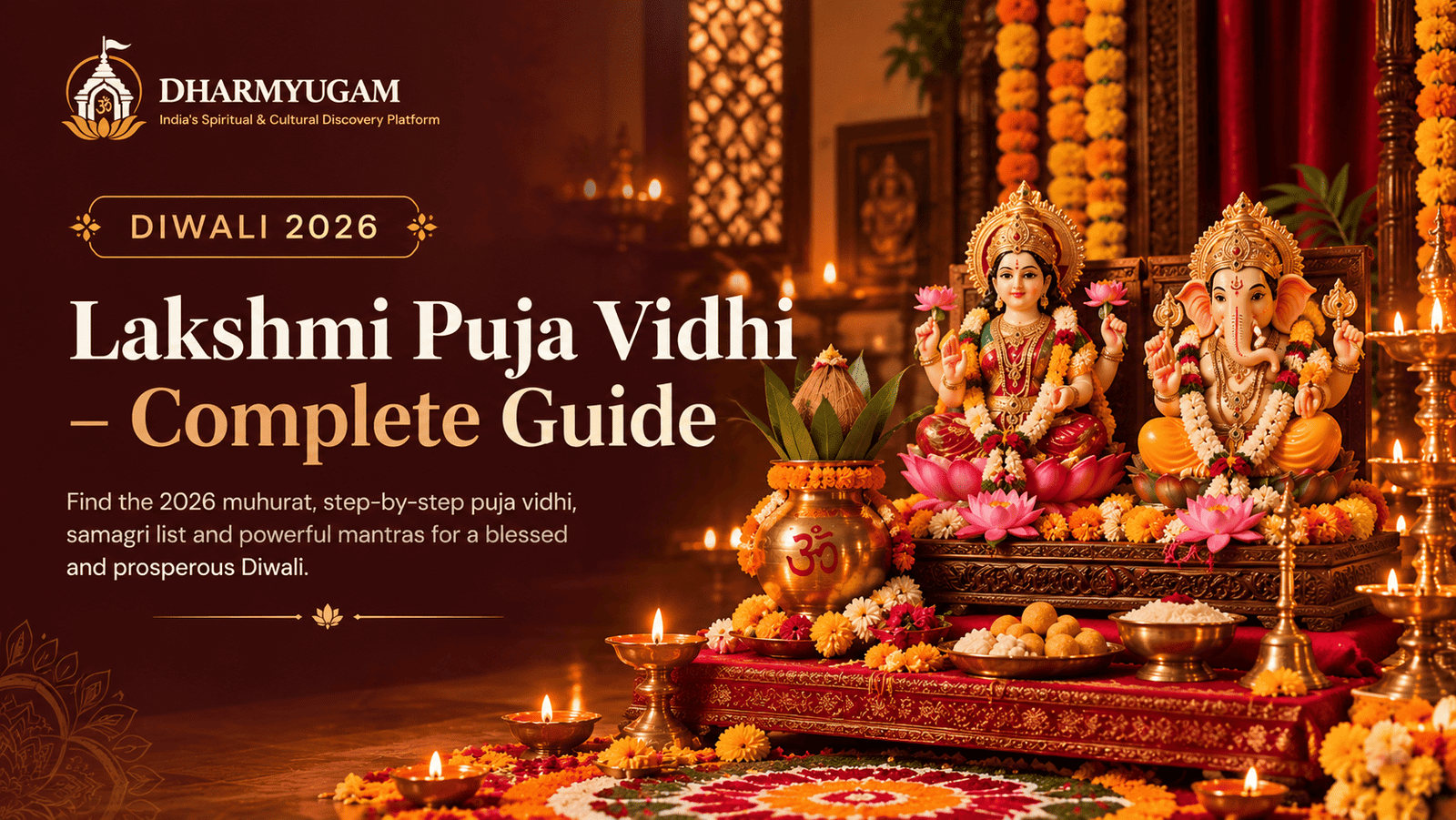
Diwali Lakshmi Puja Vidhi: Complete Step-by-Step Guide for Diwali 2026
Diwali is not just a festival of lights. It is a time when homes are cleaned, diyas are lit, families come together, and prayers are offered for peace, prosperity and auspicious beginnings.
One of the most important traditions of Diwali is Lakshmi Puja, the worship of Goddess Lakshmi along with Lord Ganesha. For many families, the evening puja is the spiritual centre of the festival.
If you are looking for a simple and authentic Diwali Lakshmi Puja Vidhi, this complete guide explains the process from beginning to end—including Diwali 2026 Lakshmi Puja Muhurat, Lakshmi Puja Samagri, Kalash Sthapana, Lakshmi-Ganesha Puja Vidhi, mantras, offerings and aarti.
Whether you are performing Lakshmi Puja for the first time or following a family tradition, this guide can help you prepare everything in advance and understand the significance behind each step.
Quick Note: Diwali Puja timings are location-specific. Always check the Panchang for your city before beginning the puja.
Diwali 2026 Lakshmi Puja Date and Muhurat
The first thing devotees usually want to know is: When is Diwali 2026 and what is the Lakshmi Puja Muhurat?
In 2026, Diwali will be observed on Sunday, November 8, 2026.
For New Delhi, the published Lakshmi Puja Muhurat is:
- Diwali: November 8, 2026
- Lakshmi Puja Muhurat: 5:54 PM – 7:50 PM
- Pradosh Kaal: 5:31 PM – 8:09 PM
- Amavasya Tithi Begins: 11:27 AM on November 8
- Amavasya Tithi Ends: 12:31 PM on November 9
The exact timing can differ between cities because Hindu festival timings are calculated using local astronomical and Panchang factors.
Therefore, if you live in Delhi, Mumbai, Bengaluru, Kolkata, Noida or another city, check the timing applicable to your location.
What is Pradosh Kaal?
Pradosh Kaal is the evening period around sunset. Diwali Lakshmi Puja is traditionally performed during the evening, and the specific Lakshmi Puja Muhurat can fall within this period.
This is why devotees should distinguish between the broader Pradosh Kaal and the specific Lakshmi Puja Muhurat.
What Is Diwali Lakshmi Puja?
Diwali Lakshmi Puja is the traditional worship of Goddess Lakshmi performed during Diwali.
Goddess Lakshmi is traditionally associated with prosperity, abundance, auspiciousness and well-being. Lord Ganesha is commonly worshipped alongside Goddess Lakshmi during Diwali as part of the Lakshmi-Ganesha puja tradition.
For many families, the ritual represents more than material wealth.
It is also a time to pray for:
- Peace in the household
- Family harmony
- Prosperity
- Stability
- Wisdom
- Good fortune
- Success in new beginnings
- Responsible use of wealth
The meaning of Diwali Puja can therefore extend beyond the ritual itself.
It can become a moment for families to pause, express gratitude and begin the coming year with positive intentions.
Diwali Lakshmi Puja Samagri: Complete Checklist
Preparing the Lakshmi Puja Samagri before the evening makes the entire puja much easier.
Rather than searching for items during the ritual, keep everything together in one place.
Essential Lakshmi Puja Samagri
You may prepare:
- Goddess Lakshmi idol or image
- Lord Ganesha idol or image
- Puja chowki
- Red or yellow cloth
- Kalash
- Clean water
- Coconut
- Mango leaves
- Roli or kumkum
- Haldi
- Akshat
- Sandalwood
- Fresh flowers
- Flower garlands
- Lotus flowers, where available
- Durva grass
- Betel leaves
- Supari
- Fruits
- Sweets
- Dry fruits
- Diya
- Cotton wicks
- Ghee or oil
- Incense sticks
- Dhoop
- Camphor
- Panchamrit ingredients
- Coins
- Naivedya
- Aarti thali
- Bell
- Clean water
- Dakshina, according to family tradition
The exact list can vary according to regional customs and family traditions.
You do not need to turn the puja into a stressful shopping exercise. If your family follows a particular puja paddhati, that tradition should guide the final list.
Diwali Lakshmi Puja Vidhi: Step-by-Step Procedure
Now let’s come to the most important part: Diwali Lakshmi Puja Vidhi.
The exact ritual can differ between communities and households. The following is a practical home-puja framework that can be adapted to your family’s tradition.
Step 1: Clean Your Home
Diwali preparations traditionally begin with cleaning the home.
Clean the main entrance, living areas and especially the place where the puja will be performed.
You can decorate the entrance with:
- Rangoli
- Diyas
- Flowers
- Toran
- Decorative lights
The puja area should be clean, organized and comfortable for everyone participating.
Step 2: Prepare the Puja Chowki
Place a clean puja chowki in the selected area.
Cover it with a clean red, yellow or traditionally preferred cloth.
Place the idols or images of Goddess Lakshmi and Lord Ganesha according to your family’s customary arrangement.
Keep the remaining Lakshmi Puja Samagri nearby.
It is helpful to arrange smaller items such as kumkum, haldi, akshat, flowers and sandalwood in separate bowls.
Step 3: Perform Kalash Sthapana
Kalash Sthapana is an important component of many Hindu puja traditions.
Take a clean kalash and fill it with water.
Depending on your family tradition, arrange the appropriate items inside or around the kalash.
Place mango leaves around the mouth and a coconut on top.
The kalash can then be decorated with kumkum, haldi or other traditional materials.
The precise procedure can vary according to regional traditions, so families should follow their established puja method where applicable.
Step 4: Begin the Puja With Lord Ganesha
The Lakshmi-Ganesha Puja Vidhi generally begins with Lord Ganesha.
Light the diya and incense.
Offer flowers, akshat, sandalwood, durva and sweets according to your tradition.
A commonly recited Ganesha mantra is:
“Om Gan Ganapataye Namah”
Recite the mantra calmly and with concentration.
For children participating in the puja, this can also be a simple opportunity to teach them the meaning of the festival and the importance of gratitude.
Step 5: Worship Goddess Lakshmi
After Ganesha worship, begin the main Lakshmi Puja.
Offer Goddess Lakshmi:
- Flowers
- Lotus flowers
- Kumkum
- Akshat
- Sandalwood
- Fruits
- Sweets
- Dry fruits
- Other traditional offerings
You can recite:
“Om Shreem Mahalakshmyai Namah”
This is a commonly used Lakshmi Puja Mantra.
You may also include Lakshmi stotras, Lakshmi Ashtottara Shatanamavali, Lakshmi Chalisa or another prayer followed by your family.
The objective should be devotional attention rather than rushing through a checklist.
Step 6: Perform Shodashopachara Lakshmi Puja
Some families perform a more elaborate Shodashopachara Lakshmi Puja.
The term refers to sixteen traditional forms of devotional offering or service.
A commonly described sequence includes:
- Avahana – invocation
- Asana – offering a seat
- Padya – offering water
- Arghya – respectful water offering
- Achamana – water offering
- Snana – ceremonial bathing
- Vastra – offering clothing
- Abharana – offering ornaments
- Gandha – offering fragrance/sandalwood
- Pushpa – offering flowers
- Dhupa – offering incense
- Dipa – offering lamp
- Naivedya – food offering
- Tambula – traditional offering
- Dakshina – offering
- Pradakshina/Namaskara – respectful conclusion
The exact sequence and details can vary between traditions.
If your family follows a particular Shodashopachara Puja Vidhi, use that established method.
Step 7: Offer Naivedya
After the main worship, offer naivedya.
Common Diwali offerings include:
- Mithai
- Fruits
- Dry fruits
- Kheer
- Coconut
- Homemade sweets
- Traditional festive foods
After the offering, the food can be distributed as prasad according to your family’s practice.
Step 8: Perform Lakshmi-Ganesha Aarti
The puja can be concluded with the traditional aarti followed by prayers and pranam.
Gather the family together for this part.
The aarti is often one of the most memorable parts of the evening because everyone participates together.
After the aarti, devotees can seek blessings from Goddess Lakshmi and Lord Ganesha.
Kartik Amavasya and Diwali Lakshmi Puja
The Diwali Lakshmi Puja is traditionally associated with Kartik Amavasya.
Amavasya refers to the new-moon tithi in the Hindu lunar calendar.
This is one reason Diwali does not occur on the same Gregorian-calendar date every year.
The festival date is determined according to the relevant lunar tithi and regional Panchang calculations.
For devotees, this means that checking the Panchang and local Lakshmi Puja Muhurat is more useful than relying only on a generic calendar date.
Why Are Lakshmi and Ganesha Worshipped Together on Diwali?
The tradition of worshipping Lakshmi and Ganesha together is widespread during Diwali.
Goddess Lakshmi is associated with prosperity and auspiciousness, while Lord Ganesha is traditionally associated with auspicious beginnings and the removal of obstacles.
Together, the worship reflects aspirations for a prosperous and auspicious beginning.
For business owners and families, Diwali can also be a time to reflect on how wealth is earned, managed and shared.
This gives the ritual a practical dimension beyond the ceremony itself.
Diwali Lakshmi Puja: Simple Preparation Checklist
Save this checklist for Diwali.
Before Puja
☐ Clean the home
☐ Clean the puja area
☐ Arrange Lakshmi and Ganesha idols
☐ Prepare the puja chowki
☐ Arrange Lakshmi Puja Samagri
☐ Prepare Kalash
☐ Arrange coconut and mango leaves
☐ Prepare flowers
☐ Prepare sweets and naivedya
☐ Prepare diyas and cotton wicks
☐ Complete rangoli
☐ Keep the aarti thali ready
☐ Check your city’s Lakshmi Puja Muhurat
During Puja
☐ Light diya
☐ Begin with Ganesha Puja
☐ Recite “Om Gan Ganapataye Namah”
☐ Perform Kalash Sthapana
☐ Worship Goddess Lakshmi
☐ Recite “Om Shreem Mahalakshmyai Namah”
☐ Offer flowers and akshat
☐ Offer naivedya
☐ Perform traditional prayers
☐ Perform aarti
☐ Take blessings
Diwali Lakshmi Puja Vidhi at Home: Practical Tips
Performing a home puja does not need to become complicated.
Prepare everything beforehand
The more preparation you complete before the muhurat, the more peaceful the actual puja will feel.
Keep children involved
Children can help arrange flowers, prepare diyas and create rangoli under adult supervision.
This turns the ritual into a learning experience rather than something they simply watch.
Follow your family tradition
There can be differences in puja procedures between regions, communities and families.
If your family already has a traditional method, preserve it.
Check your local muhurat
The Lakshmi Puja timing can differ according to location.
Keep fire safety in mind
Diyas, incense and candles should be placed away from curtains, paper, electrical wires and other flammable materials.
Extra care is important when children or pets are around.
Diwali Lakshmi Puja Vidhi FAQs
1. What is Diwali Lakshmi Puja Vidhi?
Diwali Lakshmi Puja Vidhi refers to the traditional procedure followed for worshipping Goddess Lakshmi during Diwali. It generally includes preparing the puja space, Kalash Sthapana, Ganesha Puja, Lakshmi Puja, mantra recitation, offerings, naivedya and aarti.
2. When is Diwali in 2026?
Diwali 2026 will be observed on Sunday, November 8, 2026. The exact puja timings should be checked according to the Panchang applicable to your location.
3. What is the Lakshmi Puja Muhurat 2026?
The Lakshmi Puja Muhurat 2026 varies by location. For New Delhi, the published Lakshmi Puja window is 5:54 PM to 7:50 PM on November 8, 2026. Devotees in other cities should check their local Panchang.
4. What is the best time to perform Diwali Lakshmi Puja?
Diwali Lakshmi Puja is traditionally performed during the evening, particularly during the auspicious period determined by the local Panchang. The specific muhurat can vary from one location to another.
5. What is Pradosh Kaal on Diwali?
Pradosh Kaal is the evening period around sunset. Diwali Lakshmi Puja is traditionally performed during this evening period, with the specific auspicious window determined through Panchang calculations.
6. What is Kartik Amavasya?
Kartik Amavasya is the new-moon tithi associated with Diwali. The main Diwali Lakshmi Puja is traditionally performed on this auspicious lunar date.
7. What items are required for Lakshmi Puja?
Common Lakshmi Puja Samagri includes Goddess Lakshmi and Lord Ganesha idols, puja chowki, cloth, kalash, coconut, mango leaves, kumkum, haldi, akshat, flowers, diya, cotton wicks, incense, fruits, sweets and other traditional offerings.
8. What is the Lakshmi Puja Samagri list for Diwali?
A basic Lakshmi Puja Samagri list includes Lakshmi-Ganesha idols, kalash, coconut, mango leaves, flowers, kumkum, haldi, rice, sandalwood, diyas, cotton wicks, incense, fruits, sweets, dry fruits and naivedya.
9. Can Lakshmi Puja be performed at home?
Yes. Many families perform Diwali Lakshmi Puja at home according to their family, regional or community traditions.
10. What is the correct Diwali Lakshmi Puja Vidhi at home?
A simple home procedure includes cleaning the house, preparing the puja chowki, arranging Lakshmi and Ganesha idols, performing Kalash Sthapana, worshipping Ganesha, worshipping Lakshmi, offering naivedya, reciting mantras and completing the aarti.
11. Why are Goddess Lakshmi and Lord Ganesha worshipped together on Diwali?
Lakshmi is traditionally associated with prosperity and auspiciousness, while Ganesha is associated with auspicious beginnings and the removal of obstacles. Their joint worship is therefore a common Diwali tradition.
12. What is the Lakshmi Puja Mantra for Diwali?
A commonly recited Lakshmi mantra is:
“Om Shreem Mahalakshmyai Namah.”
It may be included during Goddess Lakshmi’s worship according to the family’s tradition.
13. What is the Ganesha Puja Mantra for Diwali?
A commonly used Ganesha mantra is:
“Om Gan Ganapataye Namah.”
It can be recited while beginning the Ganesha portion of the Lakshmi-Ganesha Puja.
14. What is Kalash Sthapana in Diwali Puja?
Kalash Sthapana is the traditional establishment of an auspicious kalash as part of the puja arrangement. A kalash is commonly prepared with water and decorated with mango leaves and a coconut, although exact practices vary by tradition.
15. How is Kalash Sthapana performed during Lakshmi Puja?
A clean kalash is generally filled with water and prepared according to the family’s puja tradition. Mango leaves and a coconut are commonly placed as part of the arrangement, followed by prayers and invocation.
16. What is Shodashopachara Lakshmi Puja?
Shodashopachara Lakshmi Puja is a traditional sixteen-part form of worship involving different offerings and devotional services to the deity. The exact sequence can vary according to the tradition being followed.
17. Is Shodashopachara necessary for Diwali Lakshmi Puja?
Not every household performs the complete Shodashopachara procedure. Some families follow a shorter traditional puja, while others perform a more elaborate ritual according to their family or regional practice.
18. Which flowers are offered during Lakshmi Puja?
Flowers commonly used during Lakshmi Puja include lotus and marigold, although the preferred flowers can vary according to family and regional traditions.
19. What sweets can be offered during Diwali Lakshmi Puja?
Traditional sweets such as ladoos, peda, barfi, kheer and other homemade or festive sweets may be offered as naivedya according to family tradition.
20. What is Naivedya in Lakshmi Puja?
Naivedya refers to food offered to the deity during worship. It may include sweets, fruits, dry fruits, homemade dishes or other traditional festive foods.
21. Should Ganesha Puja be performed before Lakshmi Puja?
In the commonly followed Lakshmi-Ganesha Puja Vidhi, Ganesha worship is performed before Goddess Lakshmi worship. Families should follow their established puja tradition where one exists.
22. What should be placed on the Lakshmi Puja chowki?
A clean cloth is commonly placed on the puja chowki, followed by the Lakshmi and Ganesha idols or images and the other items required for the puja according to the family’s tradition.
23. Which direction should Lakshmi and Ganesha face during Diwali Puja?
The placement and direction of the deities can vary according to different traditions and household practices. If your family follows a specific puja paddhati, follow that established arrangement.
24. Can Lakshmi Puja be performed without a priest?
Yes. Many families perform Diwali Lakshmi Puja at home without a priest by following their family tradition, a trusted puja paddhati or a simple step-by-step procedure.
25. How long does Diwali Lakshmi Puja take?
The duration depends on the procedure followed. A simple home puja may be relatively brief, while an elaborate Shodashopachara Lakshmi Puja with additional prayers and rituals can take considerably longer.
26. What should be done before Diwali Lakshmi Puja?
Before the puja, clean the home and puja area, arrange the idols, prepare the chowki, organize the Lakshmi Puja Samagri, prepare the kalash, arrange flowers and offerings, and check the appropriate local Lakshmi Puja Muhurat.
27. Can children participate in Diwali Lakshmi Puja?
Yes. Children can participate in age-appropriate ways, such as arranging flowers, helping prepare the puja area, learning simple mantras and understanding the cultural significance of Diwali. Diyas and other flames should always be handled with appropriate adult supervision.
28. Does Lakshmi Puja Muhurat vary from city to city?
Yes. Panchang-based festival timings can vary according to geographical location. Therefore, the Lakshmi Puja Muhurat 2026 for Delhi may differ from the timing for Mumbai, Kolkata, Bengaluru, Chennai or another city.
29. What should we do after Diwali Lakshmi Puja?
After completing the puja, families traditionally perform aarti, receive blessings, distribute prasad and continue their Diwali celebrations. Diyas should be placed and monitored safely, especially around children and pets.
30. What is the significance of Diwali Lakshmi Puja?
Diwali Lakshmi Puja is traditionally associated with prayers for prosperity, auspiciousness and well-being. For many families, it is also a time to express gratitude, come together with loved ones and begin a new period with positive intentions.
Diwali Lakshmi Puja Vidhi: Final Thoughts
The beauty of Diwali Lakshmi Puja Vidhi lies not only in completing each ritual step but also in the intention behind the celebration.
Cleaning the home, arranging the puja space, lighting diyas, worshipping Goddess Lakshmi and Lord Ganesha, offering naivedya and gathering the family together all create a meaningful spiritual experience.
For Diwali 2026, prepare your Lakshmi Puja Samagri in advance, check the Panchang for your location, perform Kalash Sthapana, follow your family’s Lakshmi-Ganesha Puja Vidhi, recite the traditional mantras and conclude with aarti and prayers.
Diwali is ultimately a celebration of light, hope, gratitude and auspicious beginnings.
May Goddess Lakshmi bless your home with prosperity, peace and abundance, and may Lord Ganesha bless every new beginning with wisdom and auspiciousness.
🪔 Shubh Deepawali 2026
Dharmyugam — India’s Spiritual & Cultural Discovery Platform
Also Read: Vastu Shastra for Home Complete Room-by-Room Guide
[…] Also Read: Diwali Lakshmi Puja Vidhi […]