

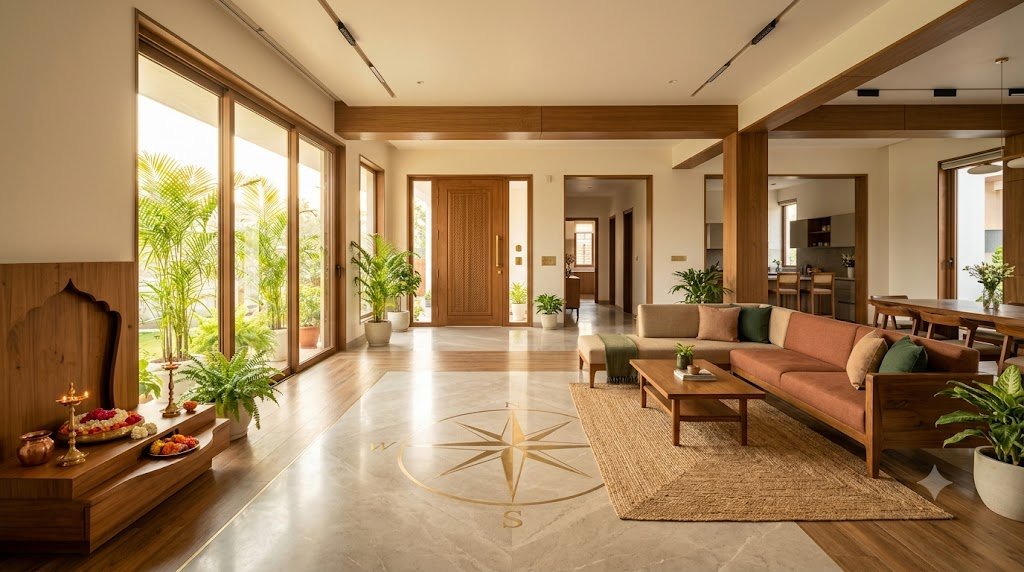
Vastu Shastra for Home: Complete Guide to Directions, Rooms, Layout and Vastu Tips
A home is more than four walls, furniture, and a roof. It is where we sleep, work, celebrate, raise families, and create memories. That is why many homeowners want their living space to feel peaceful, balanced, comfortable, and welcoming. This is where Vastu Shastra for Home becomes relevant.
Vastu Shastra is a traditional Indian system of architecture and spatial planning that considers directions, proportions, natural elements, room placement, entrances, and the relationship between people and their surroundings. For generations, families have used Vastu principles while buying plots, designing houses, arranging rooms, and even selecting furniture.
Today, the way we build homes has changed considerably. Apartments, compact floor plans, open kitchens, work-from-home spaces, modular furniture, and high-rise buildings are now common. Yet interest in Vastu Shastra for Home remains strong because homeowners are looking for ways to combine traditional principles with modern lifestyles.
The good news is that following Vastu does not necessarily mean completely redesigning your home. Understanding the basic principles can help you make more thoughtful decisions about the Vastu home layout, entrance, bedrooms, kitchen, prayer area, natural light, ventilation, and use of different spaces.
In this guide, we will explore the fundamental principles of Vastu Shastra for Home, the importance of Vastu directions, the Five Elements or Pancha Bhutas, room-by-room recommendations, common Vastu mistakes, and practical ways to create a more balanced home.
What Is Vastu Shastra for Home?
Vastu Shastra for Home refers to the application of traditional Vastu principles when planning, constructing, decorating, or arranging a residential property.
The word “Vastu” is traditionally associated with a dwelling or place of habitation, while Shastra refers broadly to a body of knowledge or teaching. Traditional Vastu concepts consider the orientation and arrangement of a building in relation to directions, natural elements, space, light, and movement.
The central idea is that different areas of a house have different characteristics. Therefore, the placement of rooms and activities is traditionally considered in relation to the home’s orientation.
For example, homeowners may consider:
- Which direction the main entrance faces
- Where the kitchen is located
- Where the master bedroom should be positioned
- Where to create a pooja or meditation area
- How much open space is available
- Where bathrooms and utility areas are placed
- How furniture is arranged
- Where heavy and light objects are positioned
- How natural light and ventilation enter the house
It is important to remember that Vastu is a traditional belief system rather than a substitute for structural engineering, architecture, building codes, or professional safety standards.
A practical approach is therefore to use Vastu as one consideration while also prioritizing structural safety, ventilation, natural lighting, accessibility, functionality, privacy, and your family’s actual needs.
1. Understanding Vastu Directions and the Five Elements
One of the first things to understand about Vastu Shastra for Home is the importance of direction.
Traditional Vastu gives significance to the four cardinal directions—North, South, East, and West—as well as the four intermediate directions—Northeast, Southeast, Southwest, and Northwest.
The center of the home is also given special importance.
The Eight Main Vastu Directions
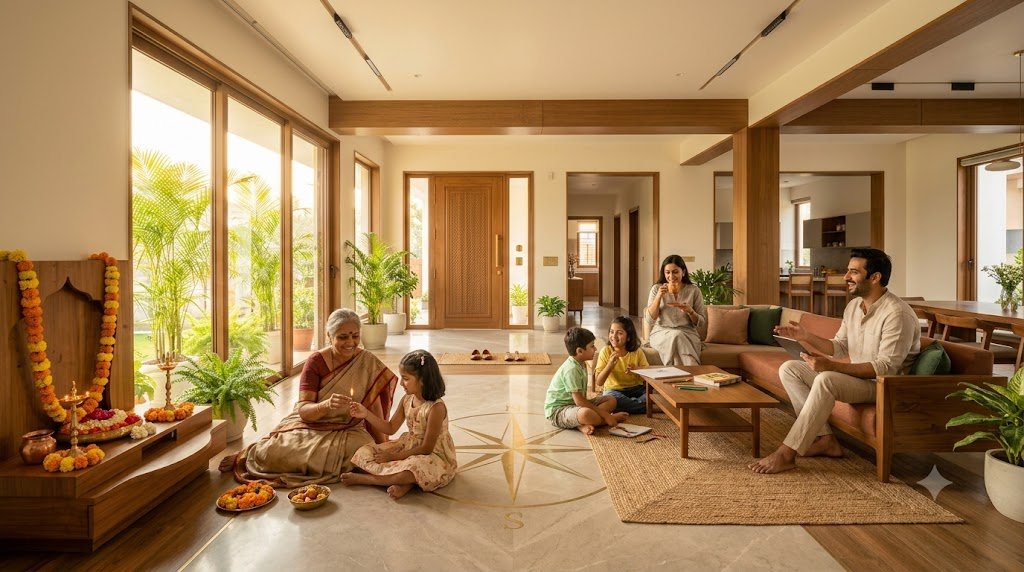
A simplified overview looks like this:
| Direction | Traditional Vastu Association | Common Residential Uses |
|---|---|---|
| North | Prosperity and movement | Living areas, storage, study depending on layout |
| South | Strength and stability | Certain bedrooms and utility spaces |
| East | Sunrise, light and vitality | Entrance, living or open spaces |
| West | Stability and completion | Dining, children’s or other functional spaces |
| Northeast | Spirituality and openness | Pooja, meditation, water/open space |
| Southeast | Fire | Kitchen and cooking activities |
| Southwest | Stability and grounding | Master bedroom and heavier areas |
| Northwest | Movement and air | Guest room, utility or transitional spaces |
These associations are part of traditional Vastu practice and can vary among schools and practitioners.
The Five Elements: Pancha Bhutas
Another important concept is the Five Elements (Pancha Bhutas):
- Earth — Prithvi
- Water — Jala
- Fire — Agni
- Air — Vayu
- Space — Akasha
Traditional Vastu connects these elements with different qualities and directions.
For example, the Southeast is commonly associated with the fire element, which is one reason the kitchen is traditionally recommended in this zone. The Northeast is associated with water and openness in many Vastu traditions.
The purpose of learning the Five Elements is not simply to memorize rules. Instead, it helps you understand the traditional logic behind many recommendations.
Why Directions Matter
Imagine two identical houses with the same furniture and floor area. If their entrances and major rooms face different directions, a Vastu practitioner may evaluate them differently.
This is why simply saying “a north-facing house is good” or “a south-facing house is bad” oversimplifies Vastu.
A home’s overall configuration matters.
The entrance position, plot shape, room placement, center of the house, slopes, open areas, and surrounding environment can all influence a traditional Vastu assessment.
2. Main Entrance Vastu: Start With the Door
The entrance is one of the most important areas when discussing Vastu Shastra for Home.
The main door is traditionally viewed as an important point through which people, movement, light, and air enter the house. Consequently, homeowners often pay particular attention to its direction, placement, appearance, and surroundings.
Main Entrance Vastu Tips
Here are some commonly followed principles:
Keep the entrance clean
Avoid allowing shoes, garbage, broken furniture, or unnecessary objects to accumulate around the main entrance.
A clean entrance creates a more organized first impression and makes everyday movement easier.
Ensure the door opens comfortably
The main door should not be obstructed by furniture, walls, plants, or other objects.
From a practical perspective, an unobstructed entrance is also safer and more convenient.
Pay attention to lighting
A well-lit entrance can make the home feel welcoming, especially during the evening.
Traditional Vastu practices also commonly favor a bright and inviting entrance.
Avoid clutter near the door
The entrance is not an ideal location for storing random boxes, unused appliances, or household junk.
If possible, create a dedicated shoe-storage area rather than allowing footwear to spread across the doorway.
Consider the entrance direction
Different Vastu traditions provide detailed guidance regarding entrances in different directions and specific sections of a wall.
Therefore, determining the exact entrance location requires more than simply identifying whether the house is north-, south-, east-, or west-facing.
What About a South-Facing House?
One of the biggest misconceptions surrounding Vastu is that a south-facing house is automatically unsuitable.
That is too simplistic.
Traditional Vastu evaluates the overall layout rather than judging a property based exclusively on one direction. A south-facing home can have different entrance placements and internal configurations.
Therefore, if you are buying a property, don’t reject it solely because it is south-facing without examining the complete floor plan.
3. Vastu Home Layout: Room-by-Room Planning
A successful Vastu home layout should balance traditional principles with the practical requirements of the people living there.
You don’t want a home that follows theoretical rules but is uncomfortable, poorly ventilated, difficult to maintain, or impractical for everyday life.
This is why Vastu for Individual Rooms is so useful.
Let’s look at the major areas of a typical home.
Kitchen Vastu: The Fire Zone
The kitchen is traditionally connected with the fire element, or Agni.
Because of this association, the South-East Direction (Agneya) is commonly considered an important location for the kitchen.
However, actual apartment layouts often make this impossible.
If your kitchen is elsewhere, don’t panic.
Instead, consider practical aspects such as:
- Stove placement
- Sink placement
- Ventilation
- Natural light
- Refrigerator location
- Storage
- Distance between water and cooking areas
- Safe movement around appliances
Traditional Vastu often recommends separating fire and water-related activities within the kitchen.
For example, some practitioners prefer the stove and sink not to be immediately adjacent.
Cooking Direction
Traditional Vastu recommendations often suggest that the person cooking should face East.
Whether or not you follow this recommendation, the kitchen should provide adequate ventilation and enough workspace to cook safely.
A good kitchen should be both functional and comfortable.
Master Bedroom Vastu
The bedroom is one of the most personal spaces in a house.
In traditional Vastu, the South-West Direction (Nairutya) is commonly associated with stability and is often recommended for the master bedroom.
This is known as Master Bedroom Vastu.
Some commonly followed recommendations include:
- Positioning the master bedroom toward the Southwest
- Keeping heavy furniture toward suitable walls
- Placing the bed in a stable position
- Avoiding direct alignment with the main door where practical
- Keeping the bedroom uncluttered
- Using calming interior colors
- Avoiding excessive electronic clutter
Bed Direction
Traditional Vastu commonly recommends positioning the bed so that the head is toward the South or East while sleeping.
Again, comfort matters.
The bed should allow easy movement around it and should not block windows, doors, heating/cooling systems, or emergency access.
Living Room Vastu
The living room is where family members gather and guests are welcomed.
For Vastu Shastra for Home, the living room can be planned by considering its relationship with the entrance, natural light, furniture, and overall movement through the home.
Depending on the house orientation and layout, Vastu practitioners may recommend different zones for the living room.
Practical considerations include:
- Keep pathways clear
- Avoid overcrowding
- Allow sufficient natural light
- Position seating comfortably
- Keep heavy furniture stable
- Avoid blocking windows
- Maintain good ventilation
A beautiful living room does not have to be filled with decorative objects.
Sometimes a simple, open layout works better.
Pooja Room Vastu
The pooja room or prayer area is traditionally given special importance.
The North-East Direction (Ishanya) is commonly considered an auspicious location for a pooja room or meditation area.
If a dedicated room is not possible, you can create a small prayer space within a suitable area of the house.
Keep it:
- Clean
- Organized
- Well ventilated
- Respectfully maintained
- Away from unnecessary clutter
The goal should be to create a peaceful environment rather than simply checking a directional box.
Study Room Vastu
Students and people working from home often want a quiet, focused workspace.
Traditional Vastu offers recommendations for study-table direction and seating orientation.
Many Vastu practitioners recommend that students sit facing East or North while studying.
Regardless of tradition, the most important practical requirements are:
- Good lighting
- Comfortable seating
- Minimal distractions
- Correct desk height
- Organized stationery
- Adequate ventilation
- Stable internet and power access for modern study needs
This is a good example of how traditional principles and practical design can work together.
Bathroom and Toilet Vastu
Bathrooms and toilets are often discussed extensively in Vastu.
Traditional recommendations may favor particular zones for these spaces while discouraging certain placements.
However, bathroom placement is often difficult to change in an existing apartment.
Instead of becoming anxious about an existing layout, focus on practical improvements:
- Fix water leaks
- Ensure proper drainage
- Maintain ventilation
- Prevent dampness
- Keep the bathroom clean
- Repair damaged tiles and fittings
- Avoid unnecessary clutter
A clean, dry, well-ventilated bathroom is beneficial regardless of your Vastu beliefs.
4. Brahmasthan and the Center of the Home
The Brahmasthan refers traditionally to the central area of a house.
It is considered an important part of Vastu planning and is often associated with openness, balance, and the movement of energy.
Traditional Vastu recommendations commonly suggest avoiding excessive heaviness or clutter in this central zone.
In a modern home, this does not necessarily mean you need a completely empty center.
Instead, you can think about visual and physical openness.
For example:
- Avoid unnecessary piles of furniture
- Maintain clear walking paths
- Don’t use the center as a dumping area
- Avoid excessive storage where possible
- Keep the area visually balanced
If your home has an open living-dining area in the center, that can naturally create a sense of spaciousness.
In traditional Vastu architecture, the Brahmasthan can be more significant in the planning stage because the entire house can be designed around it.
For an existing apartment, however, structural changes may be impractical or unsafe.
Never remove a structural wall simply to satisfy a Vastu recommendation without consulting a qualified structural professional.
5. Creating a Vastu-Compliant House Plan Without Losing Practicality
A Vastu-Compliant House Plan is usually developed by considering orientation, room placement, entrance position, proportions, open areas, and the traditional relationship between directions and activities.
If you are constructing a new home, Vastu can be considered from the beginning.
Start With the Plot
Before designing the house, examine:
- Plot shape
- Road position
- Main entrance possibilities
- North direction
- Natural light
- Surrounding buildings
- Drainage
- Ventilation
- Parking requirements
- Setbacks
- Local building regulations
Then Plan the Major Zones
Instead of beginning with furniture, identify the major functional areas:
- Entrance
- Living area
- Kitchen
- Bedrooms
- Bathrooms
- Pooja/meditation space
- Dining area
- Utility area
- Staircase
- Parking
Traditional Vastu can then be considered while deciding their placement.
Don’t Sacrifice Functionality
Suppose a particular room position technically follows a Vastu recommendation but leaves the kitchen poorly ventilated.
That is not necessarily a good design decision.
Likewise, if moving a bedroom creates poor privacy or blocks natural light, the practical consequences need to be considered.
The best approach is to find a balance.
Common Vastu Mistakes Homeowners Should Avoid
Even people who follow Vastu carefully can make mistakes by focusing too much on isolated rules.
1. Judging a house only by its facing
House direction is important in traditional Vastu, but it is not the entire assessment.
2. Following every online remedy
The internet contains thousands of Vastu remedies, and many contradict each other.
Don’t blindly follow every recommendation you see on social media.
3. Making expensive structural changes unnecessarily
If you already live in a home, you usually don’t need to rebuild the property because one room isn’t in the traditionally preferred zone.
4. Ignoring ventilation
A room should not become dark and poorly ventilated simply because of a Vastu rule.
5. Creating clutter in the name of remedies
Adding dozens of objects, crystals, decorative items, plants, mirrors, or symbols can make a home more crowded.
6. Treating Vastu as a guarantee
Vastu should not be treated as a guarantee of wealth, health, relationships, or career success.
Your environment can influence comfort and behavior, but life outcomes depend on many factors.
7. Ignoring professional building advice
Structural safety, electrical systems, plumbing, fire safety, accessibility, and building regulations should always take priority over cosmetic Vastu changes.
Practical Vastu Tips for Existing Homes
You don’t need to build a new house to apply the principles of Vastu Shastra for Home.
Small changes can make your home more organized and comfortable.
Declutter Regularly
Remove objects that you don’t use.
A clutter-free home usually feels more spacious and easier to maintain.
Improve Natural Light
Open curtains and blinds during the day where practical.
Use mirrors carefully to increase the feeling of brightness without creating glare.
Improve Ventilation
Allow fresh air to circulate whenever weather and outdoor conditions permit.
Use exhaust fans in kitchens and bathrooms.
Repair Broken Items
Fix leaking taps, broken furniture, damaged doors, loose handles, and malfunctioning lights.
These changes improve the actual usability of your home.
Organize the Entrance
Keep shoes, bags, umbrellas, packages, and other daily-use items organized.
Keep the Northeast Clean and Open Where Practical
Traditional Vastu places considerable importance on the Northeast or Ishanya zone.
If possible, avoid turning this area into a storage dump.
Keep the Southwest Stable
Traditional Vastu often associates the Southwest with stability.
Heavy furniture and primary bedroom functions are commonly placed here depending on the overall plan.
Use Plants Thoughtfully
Indoor plants can add natural texture and improve the visual atmosphere of a room.
However, choose plants based on light availability, maintenance requirements, pets, and indoor conditions rather than Vastu alone.
Vastu Shastra for Home and Modern Apartments
One of the biggest questions today is whether traditional Vastu can work with modern apartment living.
The answer depends on how rigidly you interpret the rules.
A person purchasing a high-rise apartment usually cannot change:
- Building orientation
- Structural walls
- Plumbing stacks
- Elevator position
- External staircase
- Balcony structure
- Neighboring apartments
Therefore, expecting a perfect traditional layout may be unrealistic.
Instead, focus on controllable elements.
For example, you may not be able to move the kitchen from one direction to another, but you may be able to improve:
- Stove placement
- Furniture arrangement
- Lighting
- Organization
- Color choices
- Entrance appearance
- Prayer area
- Desk orientation
- Bedroom arrangement
This practical approach makes Vastu Shastra for Home much easier to apply in contemporary properties.
How to Evaluate a Home Before Buying
If Vastu matters to you, don’t wait until after purchasing the property.
Before buying a home, examine the complete floor plan.
Step 1: Identify North
Use a reliable compass or architectural plan to establish orientation.
Step 2: Locate the Main Entrance
Determine the direction and approximate position of the entrance.
Step 3: Mark the Eight Directions
Divide the floor plan into the major directional zones.
Step 4: Identify the Center
Locate the approximate Brahmasthan.
Step 5: Check Major Rooms
Mark:
- Kitchen
- Master bedroom
- Pooja room
- Bathrooms
- Living room
- Study
- Balcony
- Utility area
Step 6: Consider Practical Factors
Do not ignore:
- Price
- Location
- Construction quality
- Natural light
- Ventilation
- Noise
- Water supply
- Parking
- Security
- Maintenance
- Connectivity
- Legal documentation
Vastu should be one part of a property decision—not the only factor.
Vastu Shastra for Home: A Balanced Approach
The most useful way to approach Vastu Shastra for Home is not to treat it as a collection of frightening rules.
Instead, think of it as a traditional framework for thinking about how a home is organized.
A well-designed home should feel:
- Comfortable
- Organized
- Safe
- Bright
- Functional
- Well ventilated
- Easy to maintain
- Appropriate for the people living there
Traditional Vastu can be incorporated into that process if it is meaningful to you.
For a new construction project, Vastu can be considered during the architectural planning stage.
For an existing home, small changes to furniture, organization, lighting, room usage, and décor may be more realistic than major structural modifications.
Most importantly, don’t let fear drive your decisions.
A home should support your life—not make you constantly worry about whether one room is in the “wrong” direction.
Frequently Asked Questions About Vastu Shastra for Home
1. What is Vastu Shastra for Home?
Vastu Shastra for Home is a traditional Indian system of architectural and spatial planning that considers directions, elements, room placement, entrances, proportions, and the relationship between a building and its surroundings.
2. Which direction is considered best for a house?
There is no single direction that automatically makes every house ideal. Traditional Vastu evaluates the entrance, floor plan, room placement, directional zones, and overall configuration.
3. Is a north-facing house good according to Vastu?
North-facing houses are traditionally considered favorable in many Vastu practices, but the exact entrance placement and internal layout are also considered important.
4. Is a south-facing house bad according to Vastu?
Not necessarily. A south-facing house is not automatically considered unsuitable. Traditional Vastu assessment depends on the complete layout, entrance location, room placement, and other factors.
5. Which direction is best for the main entrance?
Traditional Vastu gives importance to entrances in different directions and specific sections of those directions. The ideal placement depends on the orientation and complete plan of the house.
6. Which direction is best for a kitchen?
The Southeast, known traditionally as the South-East Direction (Agneya), is commonly associated with the fire element and is frequently recommended for kitchens.
7. Which direction is best for a master bedroom?
The Southwest or South-West Direction (Nairutya) is commonly recommended for the master bedroom in traditional Vastu practices.
8. Where should a pooja room be located?
The North-East Direction (Ishanya) is traditionally considered an important location for a pooja room or meditation area.
9. What is Brahmasthan?
Brahmasthan refers to the central area of a house in traditional Vastu. It is generally associated with openness and balance, and many Vastu traditions recommend avoiding excessive clutter or heaviness there.
10. What are the Five Elements in Vastu?
The Five Elements or Pancha Bhutas are Earth, Water, Fire, Air, and Space. Traditional Vastu connects these elements with different qualities and areas of a building.
11. Can Vastu be applied to apartments?
Yes. While structural changes may be limited in apartments, homeowners can consider furniture placement, room usage, entrance organization, lighting, and other controllable features.
12. What should I do if my house is not Vastu compliant?
Don’t panic. First identify which aspects concern you. For an existing home, consider practical changes such as decluttering, improving ventilation, reorganizing furniture, and adjusting room usage where feasible.
13. Is Vastu scientifically proven?
Vastu Shastra is a traditional cultural and architectural system. Its spiritual and energy-related claims should not be treated as scientifically established facts. However, some practical principles involving light, ventilation, spatial organization, and orientation can overlap with good architectural design.
14. Can Vastu guarantee wealth or success?
No. Vastu should not be considered a guarantee of financial success, health, career growth, or relationships. These outcomes depend on numerous personal, social, economic, and environmental factors.
15. Which direction should I face while sleeping?
Traditional Vastu commonly recommends sleeping with the head toward the South or East. Personal comfort, bedroom temperature, noise, mattress quality, and other practical factors also matter.
16. Which direction should a study table face?
Many traditional Vastu recommendations suggest that students face East or North while studying. Regardless of direction, good lighting, comfortable seating, and minimal distractions are important.
17. What should be kept in the Northeast corner?
Traditional Vastu often favors keeping the Northeast or Ishanya zone relatively open, clean, and light. Pooja or meditation spaces and certain water-related features may also be associated with this direction.
18. Should I buy a house only because it follows Vastu?
No. A home purchase should also consider location, budget, structural quality, legal documentation, ventilation, natural light, neighborhood, connectivity, maintenance, and your family’s requirements.
19. Can I correct Vastu without breaking walls?
Often, homeowners can make non-structural adjustments involving furniture, clutter, room usage, lighting, colors, and organization. The appropriate approach depends on the specific property and the Vastu concern.
20. What is the most important principle of Vastu for a home?
There isn’t one universal rule. A balanced approach considers the entrance, directions, room placement, elements, center of the home, and overall functionality. For modern homes, practical design and safety should remain essential priorities.
Final Thoughts on Vastu Shastra for Home
A home should ultimately make your life easier, calmer, and more comfortable.
Vastu Shastra for Home provides a traditional framework for thinking about direction, space, elements, room placement, and the way different areas of a house are used. Concepts such as Vastu directions, the Five Elements (Pancha Bhutas), Main Entrance Vastu, North-East Direction (Ishanya), South-East Direction (Agneya), South-West Direction (Nairutya), Brahmasthan, and Vastu for Individual Rooms can help you understand the traditional reasoning behind many residential recommendations.
At the same time, modern homeowners should avoid turning Vastu into a source of unnecessary fear or expense.
Whether you’re designing a new property, buying an apartment, renovating your current home, or simply rearranging furniture, aim for a balance between tradition and practicality.
A thoughtful Vastu-Compliant House Plan should not only respect traditional principles—it should also provide good light, ventilation, safety, privacy, accessibility, and everyday comfort.
The best Vastu home layout is ultimately one that works for the people who live in it.
If you are planning a new home, start by understanding your plot orientation and floor plan before making major decisions. And if you already have a home, begin with simple improvements such as decluttering, better organization, natural light, ventilation, and thoughtful furniture placement.
Use Vastu as a guide, not a source of fear—and design your home around the life you actually want to live.
Try Vastu Tools hub
[…] Also Read: Vastu Shastra for Home Complete Room-by-Room Guide […]