

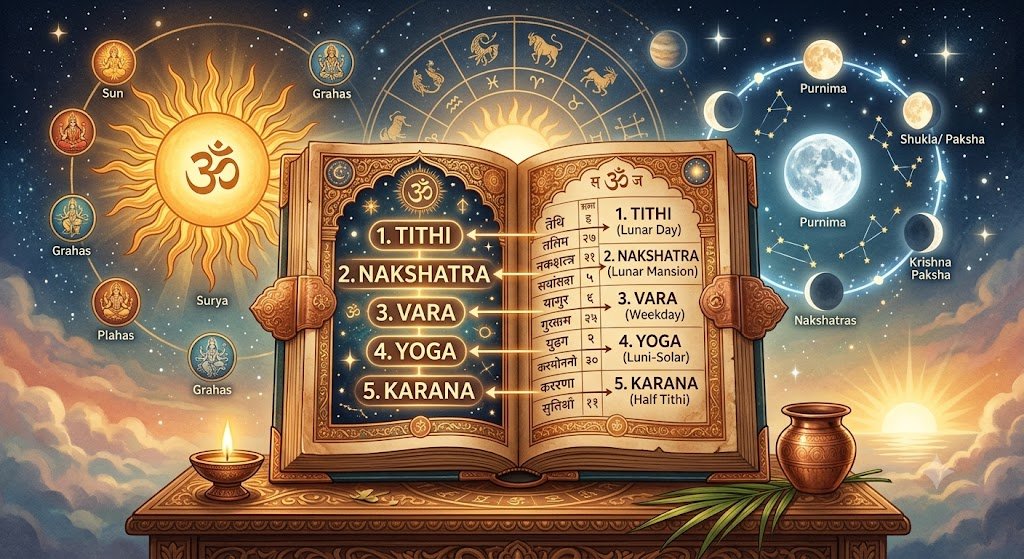
How to Read a Daily Panchang: Your Complete Guide to the Vedic Almanac
Have you ever opened a Panchang app or looked at a traditional Hindu calendar and felt completely lost? You’re not alone. Between the Sanskrit terms, the multiple time entries, and the astronomical calculations, reading a Panchang can initially feel like deciphering an ancient code. But here’s the truth: once you understand what each element means, reading a Panchang becomes a simple two-minute habit that can transform how you plan your day.
I remember the first time I genuinely tried to read a Panchang. I was planning my sister’s wedding, and the priest kept mentioning specific Tithis, Nakshatras, and Shubh Muhurat timings. I nodded along, pretending to understand, while internally I was completely lost. It wasn’t until I sat down with a patient elder and a printed Panchang that the pieces finally clicked into place.
A Panchang—from the Sanskrit pancha (five) and anga (limbs)—is the traditional Hindu almanac that describes the quality of each day through five key timekeeping elements. Unlike the Gregorian calendar that tracks only solar dates and clock time, the Panchang is a lunisolar system that tracks both the Sun’s position and the Moon’s precise orbit. This makes it uniquely suited for determining auspicious timings, festival dates, fasting observances, and the daily rhythm of Vedic life.
What makes the Panchang particularly fascinating—and occasionally confusing—is that it isn’t fixed. The values change throughout the day, and they differ by city because they’re calculated from local sunrise and sunset. A Panchang for Delhi will have different Rahu Kaal timings than one for Chennai or Mumbai. This location-based precision is what makes it such a powerful tool for daily planning.
In this guide, I’ll walk you through everything you need to know about reading a daily Panchang. We’ll cover the five core elements, the auspicious and inauspicious time windows, the astronomical foundations, and how to actually apply this ancient wisdom to your modern life. By the end, you’ll be able to open any Panchang and immediately understand what the day has in store.
The Five Limbs of the Panchang: Understanding the Core Elements
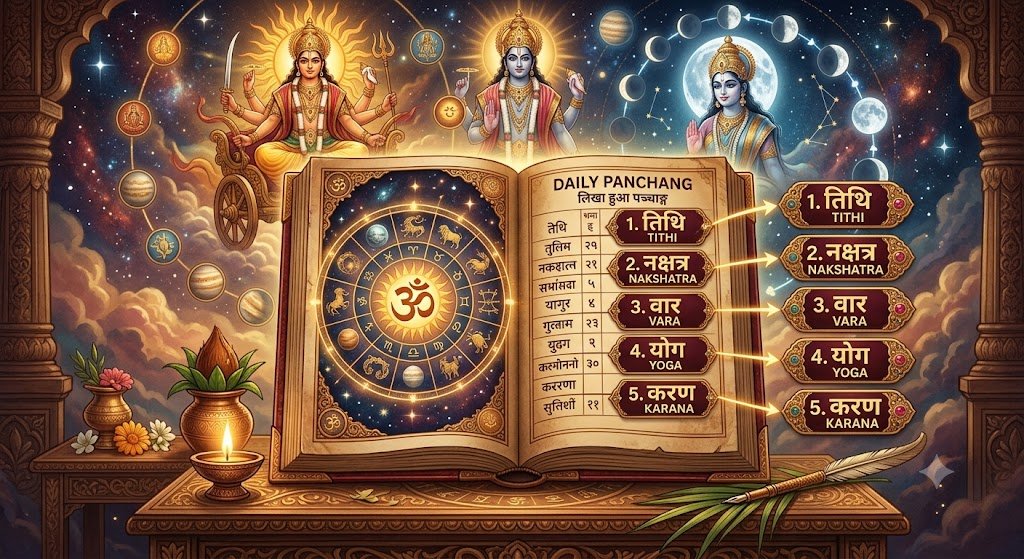
The word “Panchang” literally means “five limbs”. These five elements—Tithi, Nakshatra, Vara, Yoga, and Karana—are computed from real astronomical positions, not arbitrary conventions. Each one answers a different question about the day’s energy, and together they paint a complete picture of what any given day offers.
Let me explain each one in a way that actually makes sense.
Vara: The Weekday and Its Planetary Ruler
Vara is the simplest element to understand—it’s simply the day of the week. But unlike the Western calendar where Monday is just Monday, in Vedic astrology each day carries the energy of its ruling planet.
The seven Varas and their planetary rulers are:
-
Ravivara (Sunday) : Ruled by Surya (the Sun)—a day for vitality, leadership, and new beginnings
-
Somavara (Monday) : Ruled by Chandra (the Moon)—a day for emotions, intuition, and travel
-
Mangalavara (Tuesday) : Ruled by Mangal (Mars)—a day for courage, action, and physical work
-
Budhavara (Wednesday) : Ruled by Budha (Mercury)—a day for learning, communication, and commerce
-
Guruvara (Thursday) : Ruled by Brihaspati (Jupiter)—a day for spirituality, teachers, and expansion
-
Shukravara (Friday) : Ruled by Shukra (Venus)—a day for marriage, beauty, and relationships
-
Shanivara (Saturday) : Ruled by Shani (Saturn)—a day for discipline, service, and introspection
When you check the Vara in a Panchang, you’re getting the day’s broadest signature. Thursday mornings, for example, are traditionally considered excellent for commercial activity and financial decisions because Jupiter (the planet of expansion and prosperity) rules the day. Wednesday, ruled by Mercury, is ideal for starting new study topics or communication-heavy work.
Tithi: The Lunar Day
If Vara is the broadest signature of the day, Tithi is arguably the most important element for festivals, fasting, and understanding the day’s emotional energy.
A Tithi is the time it takes for the longitudinal angle between the Moon and the Sun to increase by 12 degrees. There are 30 Tithis in a lunar month, divided into two fortnights or Pakshas:
-
Shukla Paksha: The waxing fortnight, from new moon (Amavasya) to full moon (Purnima)
-
Krishna Paksha: The waning fortnight, from full moon to new moon
Because the Moon’s speed varies depending on its distance from Earth, a Tithi can last anywhere from 19 to 26 hours. This is why you’ll sometimes see two Tithis listed for a single calendar date—the first ends and the second begins partway through the day.
Each Tithi carries a distinct quality. Some are broadly auspicious, others are better avoided for specific activities. Here’s a quick cheat sheet:
-
Pratipada (1st Tithi) : Favors beginnings and new starts
-
Panchami, Saptami, Dashami: Generally favorable
-
Ashtami, Chaturdashi: Traditionally avoided for new ventures
-
Ekadashi (11th Tithi) : Sacred fasting day observed in both Pakshas
-
Purnima (Full Moon) : Broadly auspicious for charity, meditation, and festivals
-
Amavasya (New Moon) : Reserved for ancestral rites and introspection
Purnima and Amavasya are emotionally heavy days, often felt physically by sensitive people. The full moon tends to amplify emotions, while the new moon is a time for turning inward.
When you look at a Panchang entry, you’ll see something like: “Tithi: Shukla Paksha Saptami until 14:23, then Ashtami”. This tells you that the 7th Tithi of the waxing fortnight is active until 2:23 PM, after which the 8th Tithi begins.
Nakshatra: The Lunar Mansion
The Nakshatra is the lunar mansion or constellation in which the Moon resides. The sky in Vedic astrology is divided into 27 Nakshatras, each spanning 13 degrees and 20 minutes of the ecliptic. The Moon takes about one day to traverse one Nakshatra.
Each of the 27 Nakshatras has a unique personality, ruling deity, and set of characteristics. For example:
-
Rohini is gentle and associated with beauty, sensuality, and growth
-
Ashwini is swift, healing, and intelligent
-
Pushya is excellent for most activities, especially financial decisions
-
Mrigashira supports travel and commerce
The Nakshatra in which the Moon sits at sunrise is the day’s Nakshatra. Some Nakshatras are considered Fixed (good for permanent activities), others are Moveable (good for travel and commerce), and others are Fierce (best avoided for sensitive ceremonies).
Your Janma Nakshatra (birth star)—the Nakshatra the Moon was in at the time of your birth—is the most important single factor in Vedic chart reading. But even if you don’t know yours, checking the daily Nakshatra can help you align your activities with the Moon’s energy.
Yoga: The Luni-Solar Combination
Now we’re getting into the more nuanced territory. Yoga in the Panchang doesn’t mean physical yoga practice. It’s a luni-solar combination calculated by adding the longitudes of the Sun and Moon and dividing by 13 degrees and 20 minutes.
Think of Yoga as the background mood of the day. While Tithi describes the lunar day and emotional phase, and Nakshatra shows the Moon’s star field and activity style, Yoga adds another layer: whether the day feels constructive, restless, sharp, steady, mixed, or spiritually inclined.
There are 27 Yogas in total, ranging from highly auspicious to inauspicious:
-
Auspicious Yogas: Siddha, Amrita, Shubha
-
Inauspicious Yogas: Vyaghata, Ganda, Vyatipata, Vaidhriti
If the day’s Yoga is Vyatipata or Vaidhriti, the whole day is considered difficult for new starts. Many practitioners check this early in their Panchang reading routine because it can override other favorable factors.
For everyday planning, don’t panic if the Yoga isn’t perfect. Use it as a tone check. If the day already has a difficult Tithi, a harsh Nakshatra, and a cautionary Yoga, you might choose a smaller action or delay a fresh beginning. If most factors are supportive, the Yoga can strengthen your confidence in the timing.
Karana: The Half-Tithi
If Yoga is the background mood, Karana is the working texture of a specific time window. A Karana is half of a Tithi—the time it takes for the Moon to move 6 degrees relative to the Sun.
There are 11 Karanas in total:
-
Seven movable Karanas that repeat through the lunar month
-
Four fixed Karanas that appear at specific points
Karana matters most when you’re choosing a start time. A day may have an overall supportive Tithi, but a particular Karana may feel better for routine work than for a public launch. Another Karana may support cleaning, repairs, audits, or finishing old tasks more than starting something new.
Karana is especially useful for short actions: submitting an application, beginning a remedy, starting a journey, making a first call, sending a proposal, or beginning a study schedule. For major life events, it should be interpreted with the full Muhurat picture.
Auspicious and Inauspicious Time Windows
Beyond the five core elements, a Panchang provides specific time windows that are either highly auspicious or best avoided. These are where the practical application of the Panchang really comes to life.
Rahu Kaal, Yamaganda, and Gulika Kalam: The Three Daily Caution Windows
Rahu Kaal, Yamaganda, and Gulika Kalam are three daily inauspicious time windows that most Panchang users check first.
Rahu Kaal is the most well-known of the three. It’s a period of approximately 90 minutes each day that is considered inauspicious for starting new ventures, signing contracts, making important decisions, or beginning any significant activity. The timing of Rahu Kaal varies by day of the week and location:
| Day | Rahu Kaal |
|---|---|
| Sunday | 4:30 PM – 6:00 PM |
| Monday | 7:30 AM – 9:00 AM |
| Tuesday | 3:00 PM – 4:30 PM |
| Wednesday | 12:00 PM – 1:30 PM |
| Thursday | 1:30 PM – 3:00 PM |
| Friday | 10:30 AM – 12:00 PM |
| Saturday | 9:00 AM – 10:30 AM |
Yamaganda and Gulika Kalam are the other two caution windows. Their timings also vary by day of the week. A complete Panchang entry will list all three:
Rahu Kalam: 1:37 PM – 3:15 PM
Yamaganda: 5:28 AM – 7:06 AM
Gulika Kalam: 9:44 AM – 11:22 AM
When planning your day, check these windows first. If you have an important meeting, contract signing, or journey, make sure it falls outside these periods. As one guide puts it: “90 seconds to check, potentially saves hours of regret”.
Vishti Karana (Bhadra): The Inauspicious Half-Tithi
Vishti Karana, also known as Bhadra, is the seventh and last of the seven movable Karanas and is considered the most inauspicious of all. Each Bhadra period spans half a Tithi, which varies from approximately 4.5 to 13 hours depending on the Moon’s speed.
Vishti Karana is associated with Yama, the god of death, and carries a karmically restrictive energy. No auspicious activity—including weddings, new ventures, travel, or ceremonies—is undertaken during Vishti Karana. This is why families often check the Panchang before scheduling important events to ensure they avoid Bhadra Kaal.
Shubh Muhurat and Abhijit Muhurta: Auspicious Timing
Shubh Muhurat is the broader term for auspicious timing determination. When you need to find the best time for a wedding, business launch, travel, or any important activity, you’re looking for a Shubh Muhurat.
One of the most reliable Shubh Muhurat windows is Abhijit Muhurta—a 48-minute window centered on local solar noon. It’s considered the single most universally auspicious time period available every day of the year. It acts as a universal shield against negative planetary alignments, making it the perfect time for starting new ventures, making investments, or any activity that doesn’t require consulting a complex astrological chart.
Abhijit Muhurta extends about 24 minutes on either side of your city’s local solar noon—the midpoint between sunrise and sunset. The clock time shifts with season and place, so always check a Panchang for the exact local window.
Other auspicious windows you’ll see in a Panchang include:
-
Brahma Muhurta: The period approximately 1.5 hours before sunrise, considered excellent for meditation and spiritual practice
-
Amrit Kaal: A generally auspicious window that varies daily
The Astronomical Foundations: How It All Gets Calculated
Behind all these terms and timings lies a sophisticated astronomical system. Understanding a bit about how the calculations work can deepen your appreciation for the Panchang’s precision.
Sunrise and Sunset Times: The Location-Based Anchors
Everything in the Panchang begins with Surya Udaya (sunrise) and Surya Asta (sunset). These are the anchors from which all other timings are derived. The day in the Hindu calendar starts with local sunrise.
This is why a Panchang is location-specific. The sunrise and sunset times differ by latitude and longitude, and since all other calculations depend on these anchors, the entire Panchang changes from city to city.
Tithi Calculation: The Sun-Moon Longitudinal Angle
As I mentioned earlier, a Tithi is defined by the longitudinal angle between the Sun and the Moon. The formula is simple in concept:
Tithi = (Moon longitude – Sun longitude) / 12°
The angular distance ranges from 0° to 360°. Dividing this by 12° gives the Tithi number. Tithis 1-15 correspond to Shukla Paksha (waxing moon), and Tithis 16-30 correspond to Krishna Paksha (waning moon).
Lahiri Ayanamsa: The Precession System
Here’s where things get really interesting from an astronomical perspective. The Lahiri Ayanamsa is the standard system used in most Vedic astrology calculations for converting tropical (Western) planetary positions to sidereal (Vedic) positions.
Ayanamsa is the difference in degrees between the tropical and sidereal zodiacs, caused by the precession of the equinoxes—the gradual westward shift of the Earth’s axis at a rate of approximately 50.3 arcseconds per year.
The Lahiri Ayanamsa (named after astronomer N.C. Lahiri) is the default system used in the official Indian Ephemeris and by most Panchang calculators. As of 2026, the Lahiri Ayanamsa is approximately 24.2 degrees. This means that a planet at 0° Aries in the tropical zodiac would be at approximately 24° Pisces in the sidereal zodiac used by Vedic astrology.
Why does this matter for reading a Panchang? Because all the positions—the Moon’s Nakshatra, the Sun-Moon Yoga, the Tithi calculations—depend on which zodiacal system you’re using. The Lahiri Ayanamsa provides the standardized reference point that ensures consistency across Panchang calculations.
Adhik Maas and Samvatsara: The Leap Month and 60-Year Cycle
The Vedic calendar is a lunisolar system, which means it tracks both the Moon’s phases and the Sun’s position. But there’s a problem: 12 lunar months add up to only about 354 days, while the solar year is about 365 days. If left uncorrected, the lunar calendar would drift through the seasons.
The solution is Adhik Maas—the intercalary or leap month. An extra lunar month is inserted approximately every 2.5 years (roughly every 32.4 lunar months) to keep the lunar and solar calendars in sync. Adhik Maas 2026, for example, runs from 17 May to 15 June. It’s also known as Purushottam Maas and is dedicated to Lord Vishnu.
At an even larger scale, the Vedic calendar operates on a 60-year cycle called Samvatsara. Each year in this cycle has a specific name and quality. This 60-year cycle provides a macro-level context for understanding the energy of any given year.
How to Actually Read a Daily Panchang: A Step-by-Step Routine
Now that we’ve covered all the elements, let’s put it together into a practical daily routine. Here’s a simple 7-step process you can follow each morning.
Step 1: Set Your Location
Open your Panchang app or almanac and confirm your city is set correctly. All timings depend on local sunrise. A Panchang for Delhi won’t work for Mumbai.
Step 2: Note Today’s Tithi
Is it Shukla Paksha or Krishna Paksha? Which numbered Tithi? What time does it end? This tells you the day’s emotional energy and whether it’s favorable for new beginnings.
Step 3: Note the Nakshatra
Which of the 27 Nakshatras is the Moon in? Is it Fixed (good for permanent activities), Moveable (good for travel and commerce), or Fierce (avoid for sensitive ceremonies)? This tells you the Moon’s energy quality for the day.
Step 4: Check the Yoga
Is it one of the two severely inauspicious Yogas (Vyatipata or Vaidhriti)? If yes, avoid major new starts today. If no, note whether it’s auspicious or neutral. This gives you the day’s background mood.
Step 5: Note Rahu Kalam
What time does Rahu Kaal fall today? Block this time window for important new activities. Also check Yamaganda and Gulika Kalam timings.
Step 6: Identify Abhijit Muhurta
Note the approximately 48-minute window around solar noon—your daily fallback auspicious window. This is your go-to Shubh Muhurat if you need to start something important and other factors aren’t perfect.
Step 7: Cross-Reference with Your Plans
If you have an important meeting, contract, or departure today, does it fall outside Rahu Kaal and during a favorable Nakshatra window?
The 30-Day Approach
If you’re new to this, don’t try to master everything at once. Here’s a recommended 30-day learning path:
-
Week 1: Check only Rahu Kaal each morning. Note it, avoid it.
-
Week 2: Add Tithi check. Note Shukla vs Krishna Paksha.
-
Week 3: Add Nakshatra. Connect the Nakshatra’s quality to your planned activities.
-
Week 4: Full five-element check before any important decision.
After 30 days, most practitioners find the check becomes intuitive.
Practical Applications: Using the Panchang in Daily Life
Reading a Panchang isn’t just an intellectual exercise—it’s meant to be used. Here are some practical ways different people can apply Panchang wisdom.
For Business Owners
-
Check Rahu Kaal before scheduling client meetings and signing appointments
-
Note Pushya Nakshatra days—ideal for financial decisions
-
Thursday mornings (Guruvara, outside Yamagandam) are particularly strong for commercial activity
For Students
-
Wednesday (Budhavara) with Nakshatras favoring learning (Shravana, Hasta, Punarvasu) are ideal for starting new study topics
-
Avoid Vishti Karana for sitting important exams if timing allows
For Travellers
-
Monday (Somavara—Moon energy for travel) with a Moveable Nakshatra (Swati, Shravana, Punarvasu) and waxing Tithi is the classic auspicious travel combination
-
Check Rahu Kaal for departure time
For Home Cooks and Farmers
-
Moon phase (Shukla Paksha) for activities with growth intention
-
Nakshatras like Rohini, Mrigashira for planting and food preparation
Conclusion: How to Read a Daily Panchang
Reading a Panchang isn’t about superstition—it’s about alignment. It’s about recognizing that time has qualities, that certain moments are better suited for certain activities, and that by paying attention to these rhythms, we can move through life with greater ease and success.
The Panchang has been used in India for over 2,000 years and remains the primary reference for choosing auspicious timings, religious observances, and daily planning. It’s not a personal horoscope—that’s a different tool entirely. A Panchang is the day itself, universal and the same for everyone in a given location.
What I love most about the Panchang is its integration of astronomy and practical wisdom. The Tithi tracks the Moon’s dance with the Sun. The Nakshatra maps the Moon’s journey through the stars. The Yoga measures the combined influence of both luminaries. The Karana refines timing down to the half-day level. And the Vara anchors it all to our familiar weekly rhythm. Together, these five limbs create a complete picture of time that’s both scientifically grounded and spiritually meaningful.
Modern technology has made the Panchang more accessible than ever. You don’t need to be a Sanskrit scholar or an astronomer to access this wisdom—there are excellent apps and websites that do all the calculations for you. But understanding what those calculations mean transforms a Panchang from a confusing chart into a practical tool for daily living.
So here’s my call to action: Start small. Tomorrow morning, open a Panchang app or check a daily Panchang website. Note the Rahu Kaal timing and plan your day around it. That’s it. Just one element. Next week, add the Tithi. The week after, add the Nakshatra. Before you know it, you’ll be reading a Panchang as naturally as you check the weather forecast.
The ancient sages who developed this system understood something profound: that we don’t just live in time—we live with time. The Panchang is their gift to us, a way of dancing with the cosmos rather than stumbling through it. All it asks is a few minutes of your morning and a willingness to pay attention.
Ready to start your Panchang journey? Open your preferred Panchang app or website right now and take a look at today’s entry. Can you spot the Tithi? The Nakshatra? The Rahu Kaal timing? You now have all the knowledge you need to understand what you’re seeing. The rest is just practice.
May your days be aligned, your timing be auspicious, and your actions find their perfect moment.
FAQs: How to Read a Daily Panchang
1. What’s the difference between a Panchang and a personal horoscope (Janam Kundli)?
This is one of the most common points of confusion. A Panchang is a universal daily almanac—it describes the quality of time itself on a given day, based on the positions of the Sun and Moon. It’s the same for everyone in your city. A horoscope (Kundli), on the other hand, is deeply personal—it’s a snapshot of the entire sky at the exact moment of your birth. You use a Panchang to pick a good day for an activity; you use a horoscope to understand your life’s broader strengths, challenges, and karmic patterns. Think of the Panchang as the daily weather forecast, and your horoscope as your personal genetic makeup.
2. Why does my Panchang app show different timings than my friend’s app in another city?
Because sunrise and sunset are location-based anchors. The Vedic day begins with local sunrise, and every single calculation—from Tithi to Rahu Kaal to Abhijit Muhurta—is computed from that exact moment. Since sunrise in Mumbai occurs nearly an hour later than in Kolkata, the resulting Karana, Yoga, and inauspicious windows will shift accordingly. Always ensure your app or website has your correct city (latitude/longitude) selected, otherwise, the timings will be off.
3. What do I do if the only available time for my event falls during Rahu Kaal or Vishti Karana?
Don’t panic—it’s not the end of the world! The Panchang is a guide, not a rigid prison. If you absolutely cannot avoid Rahu Kaal or Vishti Karana (Bhadra) , you have a few workarounds:
• Start the ritual/activity a few minutes before the inauspicious window begins, and let it run through the window. The start time is what matters most.
• Use the Abhijit Muhurta (solar noon) window if it doesn’t conflict—it’s considered a universal shield that overrides minor negatives.
• Perform a small act of charity (like feeding a cow or donating grains) just before starting, which is believed to mitigate the harsh effects of these periods.
4. I see two Tithis listed for the same date. How do I know which one is active?
Because a Tithi is based on the angular distance between the Sun and Moon (12° per Tithi), and the Moon’s orbital speed varies, a Tithi can last anywhere from 19 to 26 hours. That means one Tithi might end at 10:00 AM, and the next one begins immediately. The Panchang will clearly show the end time of the current Tithi. For example: “Tithi: Shukla Paksha Dashami until 10:15 AM, thereafter Ekadashi“. This means Dashami is active until 10:15 AM; after that, Ekadashi governs the rest of the day. For fasting (vrata), you usually follow the Tithi that is prevailing at sunrise.
5. What exactly happens during Adhik Maas, and should I do anything differently?
Adhik Maas (the Vedic leap month) is an extra lunar month added roughly every 2.5 years to realign the lunar and solar calendars. It’s also known as Purushottam Maas and is considered highly sacred—dedicated entirely to Lord Vishnu. Unlike regular months, no major new beginnings (like weddings, housewarmings, or starting a new business) are traditionally performed during Adhik Maas. Instead, it’s a month devoted to intense spiritual practices—extra chanting, fasting, charity, penance, and scripture study. It’s a “pause button” for worldly activity and a “play button” for inner reflection.
6. Which of the five elements (Tithi, Vara, Nakshatra, Yoga, Karana) is the most important to check daily?
For daily, routine life—checking Rahu Kaal and Tithi offers the biggest practical return. Rahu Kaal helps you avoid unnecessary friction in your day, and Tithi tells you whether you’re in a waxing (expansive) or waning (contraction) phase. However, for major life decisions (weddings, business launches, property purchases), astrologers look at all five elements together, giving special weight to the Nakshatra (since it reflects the Moon’s exact energy) and ensuring the Yoga isn’t one of the severely inauspicious ones like Vyatipata or Vaidhriti.
7. Are Panchang calculations affected by daylight saving time (DST)?
Yes, absolutely. Since the Panchang relies on local mean time derived from actual sunrise, if your region observes DST, you must adjust your clock accordingly. However, most modern Panchang apps automatically handle DST by calculating the true solar position for your GPS coordinates, independent of governmental clock changes. If you’re using a printed Panchang for a region that uses DST, you’ll need to manually shift the given timings by the DST offset (usually +1 hour) to match your wall-clock time.
8. Why does my daily Panchang mention the Lahiri Ayanamsa, and do I need to care about it?
You don’t need to do anything with it, but it’s good to know why it’s there. The Lahiri Ayanamsa is the standard mathematical correction used in Indian astrology to account for the Earth’s wobble (axial precession) over centuries. It ensures that the Nakshatra and planetary positions in your Panchang are astronomically accurate in the sidereal zodiac. Virtually all modern Panchang apps and official government almanacs (like the Indian Ephemeris) use the Lahiri Ayanamsa as their default. If you ever compare your Panchang with one from a different region or tradition and see a slight difference in Nakshatra timing, a different ayanamsa system is likely the culprit.
9. Can non-Hindus or non-believers use the Panchang for practical benefits?
Absolutely! You don’t need to be Hindu or have any specific belief system to benefit from the Panchang’s timing wisdom. Think of it purely as an ancient, astronomically-derived productivity tool. The Tithi and Nakshatra simply reflect the Moon’s gravitational and emotional pull on the Earth (which affects tides, water in our bodies, and even human mood—a scientifically documented phenomenon). Avoiding Rahu Kaal for important meetings is no different than avoiding rush-hour traffic for a smooth commute. Use it as a practical scheduling guide, and let the results speak for themselves.
10. How can I find the most accurate Shubh Muhurat for a wedding or housewarming without hiring an astrologer?
While complex events like weddings require a full astrological consultation (because they factor in the couple’s birth charts), you can get a general Shubh Muhurat for smaller ventures by following this simple checklist:
• Avoid Rahu Kaal, Yamaganda, and Gulika Kalam.
• Avoid Vishti Karana (Bhadra) .
• Avoid days with Vyatipata or Vaidhriti Yoga.
• Choose a Tithi from the Shukla Paksha (waxing moon), especially 2nd, 3rd, 5th, 7th, 10th, 11th, or 13th.
• If you’re really unsure, fall back on Abhijit Muhurta—the universal “safe zone” around solar noon that works for almost anything. For major milestones, though, always consult a professional astrologer!
11. Why do Panchang timings and festival dates differ depending on location?
12. Can I start a major project during Rahu Kaal if the Tithi and Nakshatra are good?
13. What is the difference between Shukla Paksha and Krishna Paksha?
-
Shukla Paksha (Waxing Phase): The 15-day period from the new moon (Amavasya) to the full moon (Purnima). It is associated with growth, expansion, and beginning new projects.
-
Krishna Paksha (Waning Phase): The 15-day period from the full moon to the new moon. It is favored for introspective tasks, spiritual disciplines, health cleanses, and releasing habits.
14. How does Abhijit Muhurat override an inauspicious time window?
15. Why is Vishti Karana (Bhadra) considered unfavorable for major ceremonies?
16. What is the significance of the 60-Year Samvatsara cycle?
Also Read:
Todays Panchang Tithi Nakshatra Yoga Karana & Rahu Kaal
[…] Also Read: How to Read a Daily Panchang […]