

Todays Panchang Tithi Nakshatra Yoga Karana & Rahu Kaal
Have you ever wondered whether today is a good day to start something important, perform a puja, begin a journey, or simply understand the significance of the date according to the Hindu calendar? That is where Today’s Panchang becomes useful.
A Panchang is much more than a traditional calendar. It provides a detailed view of the day based on five fundamental elements known as Pancha Anga, or the five limbs of timekeeping: Tithi, Vara, Nakshatra, Yoga, and Karana. Along with these core elements, a daily Panchang can provide Rahu Kaal, Yamaganda Kaal, Gulika Kaal, Shubh Muhurat, Choghadiya, sunrise, sunset, moonrise, moonset, and several other time periods.
For people who follow Hindu traditions, checking the Panchang can be part of everyday life. Someone may check it before scheduling a religious ceremony, while another person may use it to find an auspicious time for a housewarming, wedding, business opening, travel, or purchase.
The important thing to understand is that Panchang timings are not necessarily identical everywhere. A reliable location-based Panchang calculates timings according to the geographical location, making local Panchang timings important when determining sunrise, sunset, Moon position, Tithi ending time, Nakshatra ending time, and Muhurat.
In this guide, we will explore Today’s Panchang: Tithi, Nakshatra, Yoga, Karana & Rahu Kaal in detail, explain what each component means, discuss auspicious and inauspicious periods, and show how the Panchang can be used practically in everyday life.
What Is Today’s Panchang?
The word Panchang comes from Sanskrit and refers to the five limbs of time. These five components are:
- Tithi – the lunar day
- Vara – the weekday
- Nakshatra – the lunar constellation
- Yoga – a specific combination of the Sun and Moon
- Karana – half of a Tithi
Together, these elements form the foundation of the traditional Panchangam, an important part of the Hindu calendar.
A daily Panchang goes beyond these five elements. Depending on the calculation system and the location, it may also display Rahu Kaal, Yamaganda, Gulika, Choghadiya, Abhijit Muhurat, Brahma Muhurta, Pradosh Time, Nishita Muhurta, Varjyam, Amrit Kalam, and other time periods.
This is why two people searching for the Panchang on the same date can sometimes see slightly different timings when they select different cities.
Why Does Location Matter in a Panchang?
The Panchang is based on astronomical calculations. The apparent positions of the Sun and Moon and local sunrise and sunset determine several daily timings.
For example, sunrise in Delhi may occur at a different time from sunrise in Mumbai. As a result, the duration and boundaries of certain time periods can also change.
A properly calculated Today’s Panchang therefore uses local coordinates and astronomical calculations rather than relying only on a fixed clock time.
This is particularly important for:
- Rahu Kaal
- Yamaganda Kaal
- Gulika Kaal
- Choghadiya
- Abhijit Muhurat
- Brahma Muhurta
- Sunrise and sunset
- Moonrise and moonset
- Tithi ending time
- Nakshatra ending time
- Puja and religious Muhurat
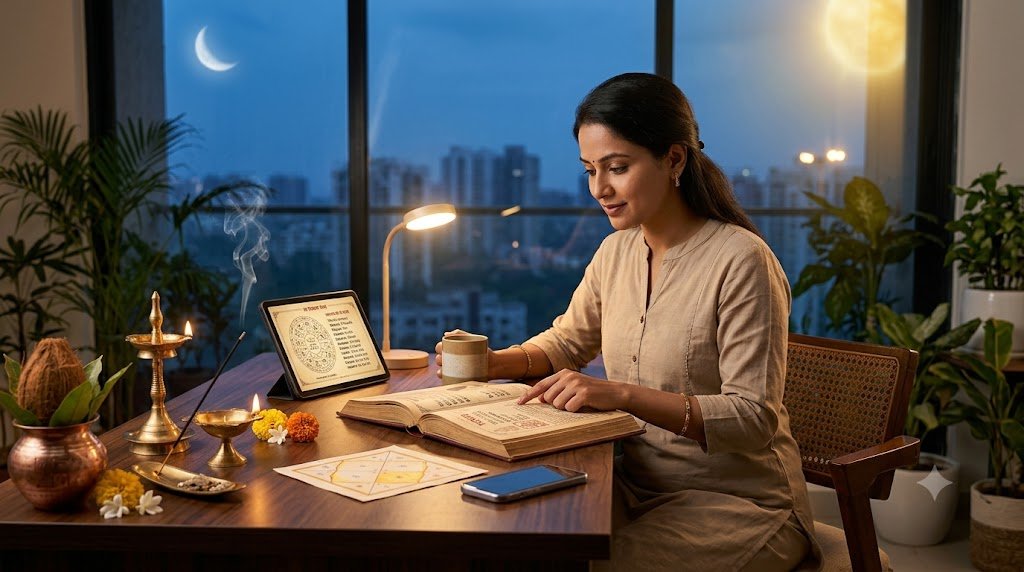
Today’s Panchang Tithi, Nakshatra, Yoga, Karana & Rahu Kaal
The five primary elements of Panchang provide the foundation for understanding the day. Let’s look at each one individually.
1. Tithi – The Lunar Day
Tithi is one of the most important components of the Hindu calendar. Unlike the Gregorian calendar, which primarily follows the solar year, the Hindu lunar calendar uses the relationship between the Sun and Moon to determine lunar days.
There are traditionally 30 Tithis in a lunar month. They are divided into two groups:
- Shukla Paksha – the waxing phase of the Moon
- Krishna Paksha – the waning phase of the Moon
Each Paksha contains 15 Tithis.
The Tithis include Pratipada, Dwitiya, Tritiya, Chaturthi, Panchami, Shashthi, Saptami, Ashtami, Navami, Dashami, Ekadashi, Dwadashi, Trayodashi, Chaturdashi, and Purnima or Amavasya.
A Tithi does not necessarily begin at midnight or last from one calendar date to the next. It can begin and end at any time of the day.
Therefore, when checking today’s Panchang, it is useful to look at the Tithi ending time rather than simply asking, “What is today’s Tithi?”
For example, if Ekadashi ends at 4:30 PM, the next Tithi begins afterward. This timing can be particularly important when observing a vrat, planning a puja, or determining a festival date.
Why Is Tithi Important?
Tithi is used for determining many Hindu religious observances, including:
- Ekadashi
- Purnima
- Amavasya
- Pradosh
- Sankashti Chaturthi
- Shivratri
- Festival and Vrat Dates
- Various puja observances
Because Tithi is calculated astronomically, its exact ending time can vary depending on location.
2. Nakshatra – The Lunar Constellation
Nakshatra refers to the lunar mansion or constellation through which the Moon is passing.
Traditional Vedic astrology recognizes 27 Nakshatras, beginning with Ashwini and ending with Revati.
The Nakshatra shown in a daily Panchang represents the position of the Moon during that period.
Just like Tithi, the Nakshatra can change during the day. That’s why a Panchang usually provides a Nakshatra ending time.
For example, today’s Panchang may show one Nakshatra during the morning and another later in the evening. If you’re planning an important ceremony based on Nakshatra, knowing the exact transition is useful.
Nakshatra Pada
Each Nakshatra is divided into four parts known as Nakshatra Pada.
The Pada provides a more detailed division of the Nakshatra and is particularly relevant in Vedic astrology, naming ceremonies, and birth-chart calculations.
The Nakshatra can also be considered alongside:
- Moon Sign
- Chandra Rashi
- Tithi
- Yoga
- Karana
- Tarabalam
- Chandrabalam
This creates a more complete picture of the day’s traditional astrological timing.
3. Yoga – A Sun-Moon Combination
In Panchang terminology, Yoga does not refer to physical yoga exercises.
It refers to a specific astronomical calculation based on the longitudinal positions of the Sun and Moon.
There are 27 Yogas in the traditional Panchang system. Some are considered favorable for particular activities, while others may be treated as less favorable.
The Yoga is therefore another important component of Today’s Panchang: Tithi, Nakshatra, Yoga, Karana & Rahu Kaal.
A Panchang may distinguish between Auspicious Yoga and combinations considered less favorable for certain activities.
However, Yoga should not be interpreted in isolation. Traditional Muhurat selection generally considers several factors together, including Tithi, Nakshatra, Vara, Yoga, Karana, planetary positions, and the purpose of the activity.
4. Karana – Half of a Tithi
Karana is another essential part of Panchang.
A Karana represents approximately half of a Tithi. Because a Tithi is divided into two Karanas, Karana changes more frequently than Tithi.
There are traditionally 11 Karanas:
- 7 movable Karanas
- 4 fixed Karanas
The seven recurring Karanas are:
- Bava
- Balava
- Kaulava
- Taitila
- Gara
- Vanija
- Vishti
The four fixed Karanas are:
- Shakuni
- Chatushpada
- Naga
- Kimstughna
Vishti Karana, also known as Bhadra in some traditional contexts, receives particular attention when selecting auspicious timings.
A daily Panchang displays the current Karana and its ending time, helping users understand the finer divisions of the lunar day.
5. Vara – The Weekday
Vara simply refers to the weekday.
The seven Varas are associated traditionally with the seven visible celestial bodies used in classical Indian astrology:
- Sunday – Ravivara
- Monday – Somavara
- Tuesday – Mangalavara
- Wednesday – Budhavara
- Thursday – Guruvara
- Friday – Shukravara
- Saturday – Shanivara
The weekday forms the fifth component of the Panchang Five Limbs.
It is also relevant when calculating certain traditional time periods, including Rahu Kaal, Yamaganda Kaal, and Gulika Kaal.
Rahu Kaal, Yamaganda Kaal & Other Inauspicious Timings
One of the most common reasons people check a daily Panchang is to find periods traditionally considered unsuitable for starting certain important activities.
What Is Rahu Kaal?
Rahu Kaal, also called Rahu Kalam, is a period associated traditionally with Rahu.
It occurs once every day, but its timing changes according to the weekday and local sunrise and sunset.
Rahu Kaal is commonly avoided for beginning important activities such as:
- Starting a business
- Beginning a journey
- Signing important agreements
- Starting a major project
- Performing certain auspicious ceremonies
It does not mean that nothing can be done during Rahu Kaal. Rather, the traditional practice is generally to avoid initiating particularly important or auspicious activities during this period when an alternative time is available.
Because Rahu Kaal depends on the length of daylight, local Panchang timings are important.
Yamaganda Kaal
Yamaganda Kaal is another period traditionally regarded as unfavorable for beginning certain important activities.
Like Rahu Kaal, its timing depends on the weekday and the local sunrise and sunset.
People commonly check both Rahu Kaal and Yamaganda when selecting a suitable time for travel, ceremonies, or important beginnings.
Gulika Kaal
Gulika Kaal, sometimes called Gulikai Kalam, is another daily time segment displayed in many Panchang systems.
Its calculation is also connected with the weekday and daytime duration.
Some traditions treat Gulika differently from Rahu Kaal and Yamaganda, so it is useful to understand that these are separate calculations rather than interchangeable terms.
Shubh Muhurat: Finding Auspicious Timings
After identifying periods traditionally avoided for important beginnings, the next question is naturally:
When is a good time?
This is where Shubh Muhurat becomes important.
A Muhurat is an auspicious period selected for a particular activity. Depending on the purpose, the calculation can involve multiple factors.
Examples include:
- Marriage Muhurat
- Griha Pravesh Muhurat
- Business opening Muhurat
- Vehicle purchase Muhurat
- Property purchase Muhurat
- Namkaran Muhurat
- Puja Muhurat
- Travel Muhurat
A daily Panchang can also show several specialized time windows.
Abhijit Muhurat
Abhijit Muhurat is traditionally regarded as a favorable period around midday.
It is often considered useful when a suitable Muhurat is needed for certain activities, although its suitability depends on the purpose and traditional rules being followed.
Brahma Muhurta
Brahma Muhurta occurs before sunrise and is traditionally associated with spiritual practice, meditation, prayer, study, and other quiet activities.
Many people use this period for:
- Meditation
- Yoga
- Prayer
- Reading
- Mantra practice
- Spiritual reflection
Because it is connected with sunrise, its exact timing changes from day to day and location to location.
Vijaya Muhurta
Vijaya Muhurta is traditionally considered a favorable period for certain activities and is often included in detailed Panchang calculations.
Godhuli Muhurta
Godhuli Muhurta is associated traditionally with the twilight period around sunset. The name itself is connected with the time when cattle return home and dust rises from the ground.
It has cultural and religious significance in Hindu tradition.
Choghadiya, Varjyam, Amrit Kalam & Other Daily Timings
A detailed Panchang can contain many more time divisions than the five basic limbs.
Choghadiya
Choghadiya divides the daytime and nighttime into several periods and categorizes them according to traditional interpretations.
The commonly recognized categories include:
- Shubh
- Labh
- Amrit
- Chal
- Rog
- Kaal
- Udveg
People often consult Choghadiya when selecting a suitable period for travel, purchases, or beginning activities.
Varjyam
Varjyam is a period shown in many Panchang systems and is traditionally considered unsuitable for initiating certain activities.
Its calculation is connected with Nakshatra-based astrology.
Amrit Kalam
Amrit Kalam is another time window that may be listed in a detailed Panchang and is traditionally considered favorable.
Because these periods depend on astronomical calculations, the exact timing can differ between locations.
Dur Muhurtam
Dur Muhurtam, or Durmuhurta, refers to a traditionally unfavorable Muhurat.
A detailed daily Panchang may display one or more such periods so users can avoid them when selecting a time for important activities.
Pradosh Time
Pradosh Time is associated particularly with the evening period around Trayodashi and is important for observing Pradosh Vrat dedicated to Lord Shiva.
The exact observance time depends on the relevant Tithi and local sunset.
Nishita Muhurta
Nishita Muhurta occurs around midnight and has particular importance for certain religious observances, especially festivals such as Maha Shivaratri.
Sunrise, Sunset, Moonrise & Location-Based Panchang
One of the most important aspects of a reliable daily Panchang is its location-specific calculation.
Sunrise and Sunset
Many Panchang calculations begin with Sunrise and Sunset.
The duration between local sunrise and sunset influences several daily time periods, including:
- Rahu Kaal
- Yamaganda
- Gulika
- Choghadiya
- Abhijit Muhurat
- Other Muhurat calculations
Therefore, using a Panchang configured for your city is preferable to simply copying timings from another location.
Moonrise and Moonset
Moonrise and Moonset are equally useful, particularly for lunar festivals and fasting observances.
For example, some vrat traditions require devotees to wait for the Moon to rise before completing the fast.
This makes local Moonrise information especially useful for:
- Karwa Chauth
- Sankashti Chaturthi
- Purnima observances
- Eclipse-related observances
- Other Moon-based religious practices
Shukla Paksha, Krishna Paksha & the Hindu Lunar Calendar
The Hindu Calendar is fundamentally different from the Gregorian calendar.
A major feature is the division of the lunar month into:
Shukla Paksha
Shukla Paksha is the waxing phase of the Moon, beginning after Amavasya and leading toward Purnima.
Krishna Paksha
Krishna Paksha is the waning phase, moving from after Purnima toward Amavasya.
The way lunar months are named can also vary according to calendar tradition.
Amanta Calendar
In the Amanta Calendar, the lunar month generally ends with Amavasya.
This system is common in several parts of India.
Purnimanta Calendar
In the Purnimanta Calendar, the lunar month ends with Purnima.
This tradition is particularly associated with several North Indian regions.
This difference can sometimes make festival dates appear confusing when comparing regional Panchangam sources.
Vikram Samvat, Shaka Samvat & Panchang Calculations
A traditional Panchang may also display multiple calendar eras.
Vikram Samvat
Vikram Samvat is a traditional Indian calendar era widely used in Hindu calendar systems.
Shaka Samvat
Shaka Samvat, also known as the Indian National Calendar era, is another calendar system that may appear in Panchang information.
These systems provide additional context for the traditional date.
How Is a Panchang Calculated?
Modern Panchang websites may look simple, but the calculations behind them are highly technical.
A traditional or digital Panchang can involve astronomical positions of the Sun and Moon, geographical coordinates, time-zone information, and various calendar conventions.
Lahiri Ayanamsha
Lahiri Ayanamsha is a commonly used reference in Indian astronomical and Vedic astrology calculations.
It helps determine sidereal planetary positions.
Drik Siddhanta / Drik Ganitha
Drik Siddhanta, also known as Drik Ganitha, refers to an astronomical calculation approach based on observational or computed astronomical positions.
Different calculation traditions can sometimes produce slight differences in displayed timings.
Geocentric Calculation
A Geocentric Calculation considers astronomical positions from the perspective of Earth.
Topocentric Calculation
A Topocentric Calculation takes the observer’s specific location on Earth into account.
These concepts help explain why a Panchang isn’t simply a fixed table of times that applies identically to every city.
Tarabalam, Chandrabalam & Moon Sign
A more detailed Panchang may include additional astrological indicators.
Chandrabalam
Chandrabalam refers to the strength or favorable position of the Moon relative to a person’s birth Moon sign or Rashi.
It can be considered when evaluating traditional Muhurat.
Tarabalam
Tarabalam is calculated based on the relationship between the individual’s birth Nakshatra and the current Nakshatra.
It is traditionally used in Muhurat selection.
Moon Sign / Chandra Rashi
The Moon Sign, or Chandra Rashi, represents the zodiac sign occupied by the Moon at a particular time.
When a daily Panchang displays Chandra Rashi along with Nakshatra and Nakshatra Pada, users can obtain a more detailed picture of the Moon’s position.
Panchang for Puja, Homa, Abhishek, Festivals & Vrat
One of the most practical applications of Panchang is religious planning.
A family preparing for a puja may want to know the correct Tithi, Nakshatra, and Puja, Homa & Abhishek Timings.
Similarly, festival dates are often determined by specific Tithis and other astronomical conditions.
A useful Panchang can help users track:
- Festival and Vrat Dates
- Ekadashi
- Purnima
- Amavasya
- Pradosh Vrat
- Sankashti Chaturthi
- Shivaratri
- Navratri
- Janmashtami
- Ganesh Chaturthi
- Diwali
- Other regional festivals
For some observances, simply knowing the calendar date isn’t enough. The exact Tithi, sunrise, sunset, Moonrise, or specific Muhurat may determine when the observance should take place.
Why Regional Panchang Dates Can Differ
One of the most confusing aspects of the Hindu calendar is that different websites sometimes show different festival dates.
This does not automatically mean one source is wrong.
Regional Panchang / Panchangam Variations can arise because of differences in:
- Location
- Sunrise
- Sunset
- Moonrise
- Lunar-month convention
- Amanta vs Purnimanta calendar
- Festival rules
- Astronomical calculations
- Regional traditions
- Drik Siddhanta or other calculation methods
For this reason, users should always check whether the Panchang is configured for their city and whether the calculation method matches the tradition they follow.
How to Read Today’s Panchang Correctly
If you are new to Panchang, the amount of information can initially feel overwhelming.
You don’t need to understand every term immediately.
Start with these five:
Tithi → Nakshatra → Yoga → Karana → Rahu Kaal
Then look at:
Sunrise → Sunset → Moonrise → Shubh Muhurat → Choghadiya
For religious observances, pay particular attention to the relevant Tithi ending time and the prescribed observance period.
For everyday decisions, you may simply want to know whether a preferred activity falls during Rahu Kaal, Yamaganda, Gulika, or another traditionally avoided period.
Example
Imagine you want to open a new shop today.
Instead of randomly choosing a time, you might:
- Check today’s Vara.
- Check the current Tithi.
- Review the Nakshatra.
- Check Yoga and Karana.
- Note Rahu Kaal.
- Avoid other relevant inauspicious timings.
- Review available Shubh Muhurat.
- Consider Choghadiya.
- Select a suitable local time.
- Confirm the timing for your exact location.
This approach turns the Panchang from a complicated calendar into a practical planning tool.
FAQ: Todays Panchang Tithi Nakshatra Yoga Karana & Rahu Kaal
1. What is Today’s Panchang?
Today’s Panchang is a daily Hindu calendar that provides information about Tithi, Vara, Nakshatra, Yoga, Karana, and other traditional time periods such as Rahu Kaal, Yamaganda, Gulika, and Shubh Muhurat.
2. What are the five elements of Panchang?
The five primary elements, known as Pancha Anga, are Tithi, Vara, Nakshatra, Yoga, and Karana.
3. What is today’s Tithi?
Today’s Tithi depends on the current astronomical relationship between the Sun and Moon. Because a Tithi can change during the day, always check its Tithi ending time for your location.
4. What is today’s Nakshatra?
Today’s Nakshatra is the lunar constellation occupied by the Moon at the relevant time. The Nakshatra may change during the day, so its ending time is also important.
5. What is Rahu Kaal?
Rahu Kaal or Rahu Kalam is a daily time period traditionally considered unsuitable for beginning certain important activities. Its timing changes according to the weekday and location.
6. Is Rahu Kaal the same every day?
No. Rahu Kaal changes every day because it is calculated using the weekday and local daylight period.
7. What is Yamaganda Kaal?
Yamaganda Kaal is another traditional time period generally regarded as unfavorable for starting certain important activities.
8. What is Gulika Kaal?
Gulika Kaal, also called Gulikai Kalam, is another daily time segment included in many Panchang systems. Its timing varies according to the weekday and location.
9. What is Shubh Muhurat?
Shubh Muhurat means an auspicious time selected for a particular activity. Different activities can have different Muhurat requirements.
10. What is Abhijit Muhurat?
Abhijit Muhurat is a traditionally favorable period occurring around midday. It is commonly included in detailed Panchang calculations.
11. What is Brahma Muhurta?
Brahma Muhurta is a period before sunrise traditionally associated with meditation, prayer, spiritual practices, study, and quiet reflection.
12. What is Choghadiya?
Choghadiya divides the day and night into traditional time periods and categorizes them according to their perceived suitability for different activities.
13. Why do Panchang timings differ between cities?
Panchang timings can differ because sunrise, sunset, Moonrise, geographical coordinates, and other astronomical factors vary by location.
14. What is the difference between Shukla Paksha and Krishna Paksha?
Shukla Paksha is the waxing phase of the Moon, while Krishna Paksha is the waning phase.
15. Why can Hindu festival dates differ between calendars?
Festival dates can differ because of location, regional traditions, Amanta or Purnimanta calendars, Tithi rules, and different astronomical calculation methods.
16. What is Nakshatra Pada?
Each of the 27 traditional Nakshatras is divided into four parts called Padas. Nakshatra Pada provides a more specific division of the lunar constellation.
17. What are Tarabalam and Chandrabalam?
Tarabalam and Chandrabalam are traditional astrological factors that may be considered when evaluating an individual’s suitability for a particular Muhurat.
18. What is Pradosh Time?
Pradosh Time refers to the evening period associated with Pradosh observance, particularly around Trayodashi Tithi and Lord Shiva worship.
19. Why are Moonrise and Moonset important in Panchang?
Moonrise can be particularly important for certain fasting observances and lunar festivals where the fast is completed after sighting or calculating the Moonrise.
20. Which Panchang should I follow?
Choose a reliable Panchang that provides location-based calculations, clearly identifies its calculation method, and matches the regional or religious tradition you follow. For important ceremonies, many people also consult a qualified priest or astrologer.
Conclusion: Todays Panchang Tithi Nakshatra Yoga Karana & Rahu Kaal
Todays Panchang Tithi Nakshatra Yoga Karana & Rahu Kaal provides much more than a traditional date. It brings together lunar days, celestial positions, weekdays, auspicious periods, inauspicious timings, and religious observances into one practical daily reference.
The five fundamental elements—Tithi, Vara, Nakshatra, Yoga, and Karana—form the foundation of Panchang. Around them are additional calculations such as Rahu Kaal, Yamaganda Kaal, Gulika Kaal, Choghadiya, Abhijit Muhurat, Brahma Muhurta, Varjyam, Amrit Kalam, Tarabalam, Chandrabalam, and various specialized Muhurats.
The most important thing to remember is that Panchang is location-sensitive. Sunrise, sunset, Moonrise, geographical coordinates, calendar conventions, and astronomical calculations can affect the final timings. That’s why checking a location-based daily Panchang is better than relying on generic timings copied from another city.
Whether you’re planning a puja, observing a vrat, checking a festival date, beginning a journey, opening a business, or simply learning more about the Hindu calendar, today’s Panchang can help you understand the traditional timing of the day.
Check your local Panchang, review the Tithi and Nakshatra, note Rahu Kaal and other relevant periods, and choose your timing thoughtfully.
Also Read: How to Read a Daily Panchang
[…] Also Read: Todays Panchang Tithi Nakshatra Yoga Karana & Rahu Kaal […]